

Buffalo’s penalty kill is improved over last season and much improved over where it was earlier this year. It’s also finding offensive chances despite the disadvantage.
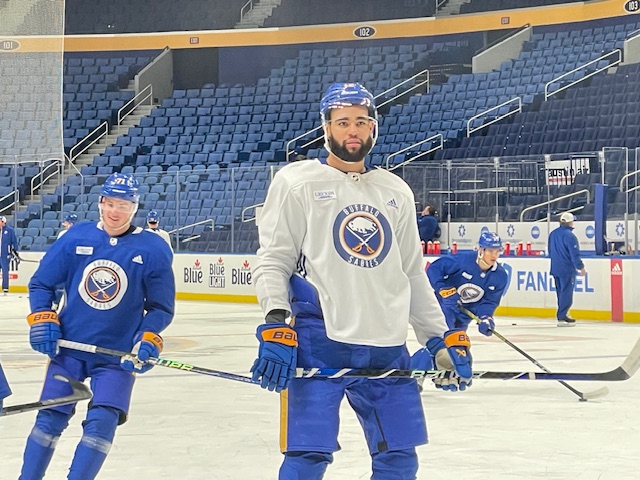
Before you delete this newsletter from your email or close the browser window in frustration, you should understand that, despite the unlikelihood of the Buffalo Sabres making the Stanley Cup Playoffs, they’re working things out that have needed to be addressed for some time in the hopes that it’ll become a strength for them in the seasons to come.
One of the biggest shortcomings of the Sabres earlier this season, and most certainly last season, was their penalty kill. Special teams might not provide the razzle dazzle fans are looking for from their favorite team, but they can sure change the perception of a game when looking back on wins and losses.
We’ve already put the bullseye on their power play this year as the leading culprit for why they’re not making the postseason, but it’s been their penalty killing that helped invigorate their strong play into the month of March.
Killing penalties isn’t sexy, but it’s a lot more exciting for the right reasons when it’s stopping opponents from scoring and creating scoring chances of their own.
“We’ve had some PK goals and that’s good because we want to be as aggressive as possible,” Alex Tuch said. “We have to be smart when we’re aggressive and we have to be aggressive together.”
Creating scoring chances when you’re supposed to be killing penalties is low on the priority list in that situation, but the Sabres have used some of their more skilled players up front on the kill to not just pressure opponents on the outside but cause full disruption of their systems.
Where that determination and that adjustment to the PK has come from is part of why it’s been so interesting to see it evolve and be effective.
The content below was originally paywalled.
For many of us, in the back (or maybe the front) of our minds, the penalty kill is meant to be filled with grinders and players that block shots, play physically, and have the reputation for making opposing teams miserable. After all, the last thing you want to do when killing penalties and potentially being stuck in your defensive end for an extended time is to burn out your best players trying to defend while outmanned.
But Buffalo has taken a different approach to the PK for most of this season, but it’s in the second half where we’re really seeing things change. We’ve watched guys like Tuch, Tage Thompson, Zach Benson, Dylan Cozens and Jack Quinn killing penalties just like we would Zemgus Girgensons, Jordan Greenway, or Kyle Okposo.
That first batch of guys aren’t any of the guys you’d expect to traditionally be in that role to kill off an opposing power play, but it’s turned into a unit that has everyone that’s part of it getting excited about hitting the ice for the challenge.
“Whenever you can find ways to put pressure on a power play, that is a positive, that’s the goal,” Greenway said. “Obviously, you’ve got one less guy, so you’ve really got to be patient and really wait for that time. But we’ve definitely been trying to find more opportunities to pressure to be aggressive and right now we’re reading it well. And we’re all working as a unit.”
Since the start of 2024, the Sabres are 80-for-101 on the penalty kill, which equates to 80.2 percent. That may not seem impressive, but if they killed penalties at that rate all year it would rank tied for 15th with Detroit. For the season Buffalo is at 78.9 percent, so the improvement is clear.
While the first half of the season saw Buffalo killing penalties via survival, the way they’ve been doing it lately is through a high-pressure defense against the puck carriers high in the zone. Doing that has led to teams flubbing shots or turning the puck over to the Sabres and occasionally springing the forwards for odd-man rushes the other way.
While the coaches lead the direction of the PK, there’s one player who’s been especially vocal about doing more with it and strategizing against other teams.
“Jordan Greenway is it,” Sabres coach Don Granato said. “He’s as good a penalty killer as there is in the league. He’s a leader. He’s talking to guys whether it’s Alex Tuch, he’s helped every guy become a better penalty killer. We run the penalty killing meetings and he shares his experience and his insight on a situation.
“He’s learned these things again and again, he’s in a window of prime of his career and now, if I think of the penalty kill, I think of that as a as an impact to the penalty kill—someone with a presence and confidence—and I think our guys just needed the nudge to know they were close. And then somebody giving them the confidence to reassure them that we are close. ‘I can physically show you how to do this.’ As a coach, you can’t hop on the ice and show anybody, but we have players that can assume that, and that leadership type role is impactful, and Jordan has been very impactful.”
Greenway is one of the most easy-going players in the locker room. He’s as chill and relaxed a guy I’ve ever seen in a locker room before, but on the ice and in practice, the switch is flipped and what he’s done to help spark any line he’s played on this year and especially the penalty kill has helped the Sabres grow up.
The Sabres developed a pack mentality on the penalty kill where it’s not just the forward forcing pressure up high but it’s how the other three skaters are positioned and making better reads off of where the initial forechecker forces the puck carrier to go next. Getting everyone on the same page is vital to the success they’ve had.
“You can’t just have one guy pressuring, right,” Greenway said. “If one guy is going to go everyone’s got to go. Everyone’s got to pressure their outs, pressure their support while having one guy kind of in the middle looking over everything. So, we definitely try and pressure the puck when we can and pressure all of the support and passing options as much as we can.”
Seeing that pressure result in shorthanded chances and the occasional shorthanded goal gave the Sabres a much-needed boost of overall confidence. Given how much the team emotionally feeds off the highs and lows, getting a big kill and even an undermanned goal provides a monstrous lift for the rest of the group.
“I think anytime you blank them on a few PKs, they start to feel the pressure more and maybe rush things and get impatient,” Cozens said. “And that’s kind of what we want to make them do is get impatient and make plays that aren’t there. And, yeah, for sure momentum when you’re feeling it in anything, it just carries.”
Even in more recent games, any power play goals they’ve allowed have been atypical of the normal style of goal. Coverages weren’t blown or guys left uncovered, but rather odd bounces and general hockey weirdness that teams can’t prepare for.
Obviously, the tenor for the rest of the season will taint the view of anything positive the team is accomplishing because (insert your favorite “screw this season” reason here), but seeing a group that went from killing penalties at a 73 percent rate a year ago to pushing nearly 80 percent for the season thanks to their second-half efforts, that’s something worth remembering for next season and to see if it carries forward as they look to right the ship once again.