


Years ago, just making the playoffs was good enough. Things have changed in a hurry.
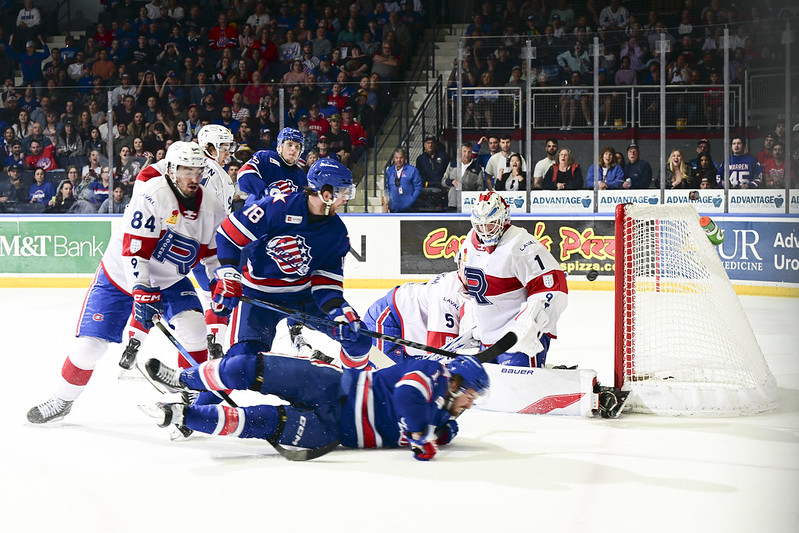
ROCHESTER – It’s hard to remember that it hasn’t been so long that the Rochester Americans have been expected to go this far in the Calder Cup Playoffs.
There was a time when poor drafting in Buffalo and the desperation to do something to help out the fans in Rochester and get winning started early for the up-and-coming players that were getting AHL time went through a rough spell. Veterans were signed for depth for the Sabres but were wink-and-nod earmarked to go to Rochester. It wasn’t a recipe for success at any level.
It’s been different though the past few years.
What started under Chris Taylor in 2017-2018 by just making the playoffs and grew under Seth Appert that led to the Americans making the Eastern Conference Finals two years ago has evolved. That season they got a taste of what it’s like to face a veteran team that’s coached extremely well and plays hockey the way it works best in the AHL. It wasn’t a series they got blown out of, but as close as many of the games were, the Bears always seemed to find the edge to win.
Last year’s second round loss to Syracuse wasn’t an “aw shucks, we’ll get ‘em next year” type of defeat, it was a bitter pill to swallow, especially since they had home ice advantage.
The quality of young players available to Rochester increased dramatically, as did the responsibilities given to them. From J-J Peterka to Jack Quinn to Lukas Rousek to Jiri Kulich, Isak Rosén and Devon Levi and now Noah Östlund and Anton Wahlberg, it’s turned things in Rochester to a mental state of “it’s nice to make the playoffs again” to “we can win the Calder Cup.”
After Appert graduated to the bench in Buffalo as Lindy Ruff’s assistant coach, Mike Leone was hired into a job that came with suddenly very high expectations. Going from coaching in the USHL to the AHL all at the age of 37 is a hell of a thing.
It’s not always easy to pick up and keep things going and yet that’s just what Leone’s Americans are doing. Their 92-point season (.639 points percentage) tied them for the fifth best record in the league, but they didn’t win the North Division because the team with the AHL’s best record, the Laval Rocket, also reside there.
This season was their best since 2018-2019 when they had 99 points and a .651 points percentage. That Americans team was led by Victor Olofsson, C.J. Smith, Zach Redmond and Scott Wedgewood in goal. What a wild concept — getting hits on draft picks while making good signings and trades pays off.
The content below was originally paywalled.
The raised bar for success in Rochester makes looking at things a lot different, though. The Americans are supposed to win, and their prospects have to contribute to make it happen all while the veteran players who have toiled and earned their ice time in the AHL provide guidance.
Once again, Rochester is in position to take a leap and they’re doing it with a mix of veterans and prospects again, this time it’s a little different than the mix they had when they faced Hershey. That year, Kulich and Rosén were rookies and Rousek was the team’s leading scorer. This year, it’s Rosén who’s their leading scorer. Rousek is a leading scorer. 2023 college free agent out of Quinnipiac Zach Metsa is the top scorer on defense and veteran Kale Clague is right there with him.
Clague is in his third year in the Sabres organization, and this was the first year in which he didn’t see any NHL games. Unlike the rest of his younger teammates, he’s getting his first taste of playoff hockey this year and thriving with five goals and four assists in five games. His ability to score on the power play forced Laval to shadow him closely after he opened the scoring in Game 2. Even though it was smart of the Rocket to do that, it also opened up the ice for Kulich later in the game when he blasted home a power play goal that proved to be the game-winner in the third period.
There’s also an important message that comes from having guys like Kulich and Clague part of the team.
Clague missed out on the playoffs the past two years because of the time he spent in Buffalo and the team not sending him there to play. Now he’s a bled-in member of the team and rising to the occasion.
Kulich forced his way onto the Sabres roster this season because of how he adapted his game to be a better fit in the NHL and for Ruff’s style of play. He performed so well that he became the team’s No. 1 center by the end of the season with Tage Thompson on his right wing and 19-year-old Zach Benson on the left. Kulich wanted to play in World Championships for Czechia, but Adams and Ruff decided it was better for him return to Rochester and be part of their push for the Calder Cup.
“My expectation for our players is that we’re going to be playing into June, over the coming years, and I want our guys used to that,” Adams said during his end-of-season press conference. “And I also think if there’s a chance to win a championship and they go down and have success, I think that would be great for Jiri’s development.”
It could’ve been humbling for Kulich to go from playing on the first line in the NHL to going back to the AHL. A lot of players would’ve looked at that as a punishment, but when you watch the AHL playoffs and how cutthroat and hard every game is played, it’s the ideal setting for young players that are expected to be part of something bigger in the NHL.
Kulich and Clague’s presences, and Devon Levi’s as well, are also important for guys like Noah Östlund, Anton Wahlberg and Konsta Helenius. Too many times in the past guys with top draft pedigree would view Rochester as a way station to the NHL. It was a place for them to putz around until the call eventually came for them to go to Buffalo. There are always questions about proper development, especially in the more recent history of the Sabres, but the time taken out to make sure guys were ready has been vital even if it hasn’t resulted in playoff appearances in the NHL.
Making sure that NHL jobs were earned and not given out just because they were taken high in the draft or ranked out high on prospect watchers’ lists makes a world of difference. Seeing the growth guys like Östlund and Helenius have made through this season helps prove the point.
Östlund’s all-around game has become much better. He can make creative plays with the puck, sure, but his attention to detail defensively has gotten much better. Helenius’s unending confidence is still there but it’s evolving in a way that drives opponents bonkers. Guys with a motor that doesn’t stop wears out foes and even though he’s got the offensive instincts and creativity to make incredible plays happen, the stereotypical Finnish doggedness on the puck is there, too, and getting better.
It’s understandable if glowing words about guys that are meant to be arriving in Buffalo in short term or near-short term don’t hit the way they used to, but there’s a big difference between the current group of Sabres prospects and some of the hopefuls of the past who for one reason or another. Even if some of the current leaders of the Americans have been Sabres hopefuls for a couple years and haven’t broken through full time yet, their time will come eventually, be it Buffalo or elsewhere.
Rochester has a wicked fight ahead of them against Laval in their best-of-five series needing to win two out of three on the road to advance to the Eastern Conference Final against either Charlotte or Hershey, but making it this far is good for the group overall, just not good enough for them and they know it.
“A lot of times what you want as a coach, too, you set the standard, there was a really good culture that was set here,” Leone said after Game 2. “You do some things differently, the way we want to play and pressure the puck. I really believe in that. I think we did a great job with that, but once it gets to a certain point, you want your players to take over the team. Take the team, grab it, and these guys have done it.
“I’m not saying we don’t coach the team, but there’s a lot of times where I don’t have to go in the room after a loss. It’s a together group; they say the right things. They know when we don’t play good. We responded all year, so we were really confident in (Game 2) and then we showed it.”