

Is Buffalo flying under the radar headed into the season or are they off the screen the way some believe they should be?
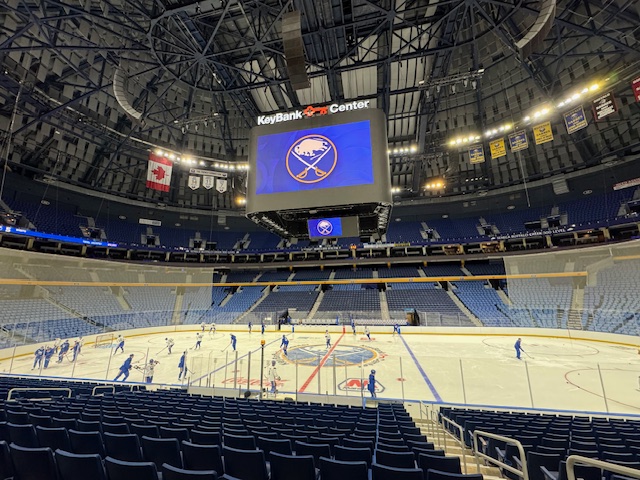
BUFFALO — Not all training camps are the same. Expectations vary year to year; players grow and evolve while others start the turn down the other side of the hill in their careers. Some are contenders, others are definitive pretenders. The Buffalo Sabres haven’t been contenders in nearly two decades and in that time, they’ve watched numerous young players take their careers forward to varying levels of success.
As these Sabres begin their season under new-old coach Lindy Ruff, they exist in a kind of purgatory in which escaping from it is as much of a goal as making the Stanley Cup Playoffs.
They’re loaded with young talent capable of tremendous feats and bound for massive personal success and brimming with potential that’s been apparent for a few players over the past few seasons. Other even younger players enter the year with the idea that they’ll take another step into the future and begin to fulfill the expectations that came with where they were taken in the NHL Draft however many years ago.
All that hopefulness is slapped in the face of the realism of the situation. The Eastern Conference is a murderous gauntlet to get through and with the divisional playoff format, the difficulty of the Atlantic Division and the stacked competition at the top of it dampens even the most optimistic hopes.
But a new season always starts with hope and the Sabres dream of finally ending their seemingly forever long playoff drought stays is alive until proven otherwise. With Ruff in charge and a new gameplan and systems in place, the skepticism surrounding their ability to make the Stanley Cup Playoffs that overwhelms the hockey world outside of KeyBank Center finds no quarter within it.
The Sabres’ cadre of top prospects set the table during the Prospects Challenge and now with camp fully underway and Ruff amping up the speed and pace of play along with a system that has forwards forechecking intensely and seeking to force turnovers deep in the defensive zone, the mood is vastly different than in many of the previous seasons.
“The guys that they brought in… a very different style and have a lot of compete and have a lot of different experiences,” Alex Tuch said. “So, I think that’s going to be really good for our group. But yeah, I don’t think we’ve ever played looking over our shoulder or anything like that. I think we’re going to go in and we have a group that’s going to play fast and physical, and we’re going to try to step on teams’ throats each day, day in and day out. So, that’s the type of hockey that we’re going to try to play, and it’s going to be good.”
More ahead on what we’ve seen through the first few days of camp, Jiri Kulich, and Rasmus Dahlin’s injury putting a scare into the start of the new season.
The content below was originally paywalled.
There’s a cliché about the best laid plans that you could throw into the mix about the start of Sabres training camp thanks to Rasmus Dahlin leaving the ice within the first five minutes of skating on Wednesday morning. Ruff described it as a mid-body issue and the Thursday update on him brought the chance to exhale over the No. 1 defenseman’s status.
“Yeah, (Dahlin’s) doing well,” Ruff said. “Just probably miss a couple of days of practice, so nothing too serious.”
Even though the Sabres have plenty of depth on the blue line, Dahlin is the one guy they cannot afford to be without. No matter how good Owen Power or Bo Byram are, Dahlin is The Man. It’s a real Captain Obvious thing to say, but the hope of starting off the season strongly takes a hit without Dahlin.
The need to get off to a good start is evident. The Sabres have run three separate groups to ensure the 57 players (Tyson Kozak and Norwin Panocha were injured during the Prospects Challenge and are off the ice for now) each get to work, but the main group consists of what will likely be their opening night roster.
In previous seasons, Don Granato would tinker with lines in search of something new and different that might work out, only to wind up going with groups that worked before but now had to spend the first few regular season games getting their chemistry back. Ruff is going about it differently with these lines:
J.J. Peterka — Tage Thompson — Alex Tuch
Zach Benson/Jiri Kulich — Dylan Cozens — Jack Quinn
Jason Zucker — Ryan McLeod — Jordan Greenway
Beck Malenstyn — Sam Lafferty/Peyton Krebs — Nicolas Aube-Kubel
Jiri Kulich being with the main group was a somewhat surprising occurrence but after he posted five goals during the Prospects Challenge and was absolutely hands-down the best player on the ice during the weekend, it’s an earned opportunity.
By now, you should know all about Kulich. He’s scored 51 goals in two AHL seasons all before he turned 20 years old. His shot is electrifying, and he was NHL-sized from the moment the Sabres selected him 28th in the 2022 draft. While the offense is outstanding, he’s young and consistency eludes him. He had a long offensive drought in Rochester last season that helped depress his goal total and he still finished with a team-leading 27.
“His skating is fabulous, his shot is really good for the age where he’s at, and he’s only getting better and better,” Rochester Americans assistant coach Vinny Prospal said. “The only thing that I can say is that he needs to be more consistent… If he’s ready, in my mind, he needs to keep that going throughout the entire season, do it in the American Hockey League, and then start knocking on the door because he doesn’t want to come (to Buffalo) for a cup of coffee. He wants to come here to stay and, unfortunately, I’ll say it as it is, take somebody’s spot.”
If the Sabres’ plan to not actively pursue a top six forward and spend the money saved after the Jeff Skinner buyout was to open the door for Kulich to win his way onto the roster, it’s one hell of a gamble given the must-win nature of the season. Kulich’s offseason was crafted in part due to the extended slump from last season, but also the desire to finally reach the NHL and doing what he must to make it happen.
“With my strength coach, we had probably the best workout this summer and I was working on the net-front and those things because I thought I’m just a shooter from the one-T spot,” Kulich said. “I need to improve on these things, and I think I’ve improved a lot from summer to now.”
His success at the Prospects Challenge and truly looking like a man among boys in that setting landed him with the main group. Now it’s up to him to take the opportunity and run with it.
“He did a lot of great things,” Ruff said. “He was the guy you noticed the most. And I’m not even looking at the offensive side of it. I mean, he’s got a bullet of a shot, which, you know, you can’t teach that. You have it or you don’t, and he’s got it. But play at this level, can you play away from the puck? Can you skate with them? His skating, I was impressed with his skating. I was impressed with his level of strength in 1-on-1 battles and keeping guys at bay too. So, very impressive young man.”
Kulich trading off reps with Zach Benson (and occasionally sliding in at center in place of Dylan Cozens — it was a rotational thing they worked on during a longer practice on Thursday, Cozens’ place in the lineup is not in danger) works out two-fold.
It gives Kulich the chance to play with guys on a scoring line and everyone can complement each other in their play. It also, perhaps, gives Benson a strong sense of competition for that spot in camp.
On paper, Peterka, Benson and Zucker were virtually locked into the roles and lines they’d play on, but with Kulich here and how he would need to be on a more offensively minded line (ideally). Kulich working with, say, Ryan McLeod and Jordan Greenway would ideally shield him more defensively, but wouldn’t lean into his superior offensive instincts. How it plays out for Kulich through camp is a fascinating story line to watch.
On Thursday, the players in the bottom six set up rotated in all kinds of permutations of lines. Krebs had Malenstyn and Lafferty as wings one time and McLeod in place of Lafferty on another go through while Lafferty slid in between Zucker and Greenway. There were other mixes in there as well, but those two lines figured to be built to be malleable like that to better find matchups and make deployment more useful. It’s a smart move because there figures to be a lot of shifting around among those players.
“It can wear the opposition out,” Ruff said regarding the fourth line. “It’s – a lot of times the opposition will go, ‘Oh, not those guys again.’ It can help in heavy schedules, back-to-back games where there’s a lot of times you need four lines. You shorten up the lengths of shifts and that line gives you 25 seconds of high energy.”
The bulk of the Sabres’ offseason acquisitions were made to reform their bottom six forward group. After they traded Kyle Okposo and lost Zemgus Girgensons to Tampa Bay in free agency, a new identity was going to happen regardless. But Adams was proactive in dictating what that would be. Adding Ryan McLeod, Beck Malenstyn, and Nicolas Aube-Kubel made them faster, more defensively focused, and more physical as well.
Malenstyn, who came over from Washington in a trade during the NHL Draft this summer, is part of the shemozzle of forwards and given his hit numbers in his limited NHL career and the impression he left at the AHL level, he’s tailor-made to be a fan favorite ASAP.
Sabres fans have clamored for years that the team isn’t anywhere physical enough and given the results over that time it’s an area that was worth addressing. With the way Malenstyn played against Rochester in the AHL Calder Cup playoffs two seasons ago, his style of play is one players, coaches and executives got to know.
“They were some great battles down against Rochester in the playoff runs there,” Malenstyn said. “It was a tough building to play in, but it was the perfect kind of atmosphere for me. It was a blue-collar crowd that liked to get physical and loud in there. There were some hard-fought battles, some blood, sweat and tears left out there. But, no, it’s great. You go out there and leave an impression and those people value you. That just makes it really exciting to be somewhere you’re wanted and valued.”
The first time he trucks a fan-hated opponent he’ll have a posse. When he does it a few more times during a game, he’ll be a cult hero.
The defense, while Dahlin briefly skated on Wednesday had this setup:
Bo Byram — Rasmus Dahlin
Owen Power — Henri Jokiharju
Mattias Samuelsson — Connor Clifton
Dennis Gilbert — Jacob Bryson
With Dahlin out on Thursday, there was a little juggle:
Bo Byram — Owen Power
Mattias Samuelsson — Henri Jokiharju
Jacob Bryson — Connor Clifton
Dennis Gilbert — Ryan Johnson
A couple of things that seem to be true here:
One of, if not both depending on how pairs shake out, Dahlin or Power will play on their off hand. For Dahlin, this is a good thing because he excels from that spot, and it leans into his offensive game. Power has the mobility and hockey smarts to also make it work from there, it’s just we haven’t seen it from him nearly as often as we have with Dahlin.
Dahlin was at the bench watching practice Thursday which would indicate to me that what he’s dealing with isn’t terribly serious. Given his body language while watching his teammates tear up and down the ice, he’s really annoyed not being out there. He knows it’s a big season for the team and for himself and to not be part of the start of it, it must be gnawing at him terribly.
Dahlin has been at the forefront of getting teammates focused for this season. He hosted a few players in Switzerland during the summer for an informal workout getaway. Kulich mentioned he took part in it with a couple other younger Sabres players as well as some of the veterans.
Dahlin is a fierce competitor and he’s deeply driven to get this group to the playoffs and while that doesn’t always come through in what he says, it’s beyond apparent in what he does.
“I think it says a lot about Rasmus, the leader that he’s grown into and become,” general manager Kevyn Adams said. “But it also says a lot about our group that, I mean, it wasn’t just Europeans that met over there. We had Owen Power, who had flown over there. Samuelsson flew over there. I mean, guys coming from North America, they love being around each other and being together, but they also push each other to get better.
“So, that’s the stuff that is out of our control in terms of management or coaches. It’s the summer. They do what they want to do. But I just think it sends a pretty good message that these guys were willing to do that in July. I think that you can’t force those type of things. It has to happen just kind of organically, which is pretty cool to see that it did.”
Adams said the Sabres will name a captain by the time they open the season against New Jersey in Prague and if it’s anyone other than Dahlin, it would be a massive surprise. That’s not to say the Sabres are lacking in captain-like players on the team, of course. Tage Thompson and Alex Tuch rose up as leaders when they spoke at the end of last season along with Dahlin, it’s just that Dahlin has been on this track to the captaincy for a couple years and now with there being a vacancy, it’s time to stitch the “C” onto his sweater.
“(Dahlin)’s an incredible player, but he’s also an incredible individual,” Tuch said. “To be able to go along into battle beside him has been a great honor, honestly, ever since I got in. And he’s raised my level of compete and he’s made me want to be a better player, and that’s what he does to each and every guy. He expects a lot of each guy, and he’s been incredible each and every game. He really puts the most amount of pressure on himself. You know, no matter what you guys say, the coaching staff says, any of us say, he puts the most amount of pressure on himself, and he rises to that pressure. And it’s been incredible to see. He’s an incredible talent, but just his work ethic and compete is like no other.”
The Sabres will scrimmage on Friday and Saturday, although they open their preseason schedule Saturday night at home against Pittsburgh. How Ruff and the staff decide to divvy up the lineup to make sure guys get at least one game in before heading to Germany will be interesting to see. Saturday and Monday afternoon’s games will be the only chance to see any of the NHL players before the home opener in October. Don’t suppose Bills fans will tailgate with the Sabres on the radio on Monday, do you?