

Buffalo’s checklist for the summer was loaded with fascinating choices
It’s August and that means we’re about a month away from the start of NHL training camp opening up. It also means we’re at the right time to take stock of what teams around the league have done to better themselves for the season to come.
In the Buffalo Sabres’ case it means taking a microscopically close look at whether or not they’ve accomplished what they needed to do to help get this team back to the Stanley Cup Playoffs for the first time since 2011.
From making coaching changes, to buyouts, to trades, to drafting and ultimately free agency, Buffalo has been busy, but has it been enough? We’re going to break things down and give it the kind of keen eye that’s needed at this dreadfully dry time for hockey happenings.
Doing this with full knowledge there is more work to be done (like Peyton Krebs getting re-signed) is always a bit of a risk, but after Ukko-Pekka Luukkonen signed his five-year deal, it feels like everything is just about in place for the upcoming season whether you approve of that or not.
Enough stalling let’s get down to business on a fascinating Sabres offseason and if it’s enough to stave off another round of déjà vu.
The content below was originally paywalled.
Coaching
The first move of the offseason saw the Sabres dismiss head coach Don Granato, assistant coach Jason Christie and video coordinator Matt Smith. It was clear from what general manager Kevyn Adams said following the move that where the Sabres were at after the season was not good enough and everything needed to be better.
“I don’t think we performed consistently enough up to our expectation of what I have, and I don’t think we were competing at a high enough level game in and game out,” Adams said in April. “Our standard needs to be higher. Period.”
Sabres players said they wanted more accountability in the room and from the coaches. They wanted standards to be better all around.
“I think at times you can see that we were a great team and other times we were too casual,” Tage Thompson said on locker clear out day following Granato’s firing. “I think that’s something that has got to be instilled in us and that kind of goes back to the accountability thing as well. What the consistency is. It’s us in here, in the room holding each other accountable if there’s someone not playing the way they need to, and obviously needs to come from up top too. And that’s something I don’t think we had enough of this year.”
They’re going to get all of that and more with Lindy Ruff in charge. Ruff is the classic old-school style of coach in his demeanor. He’ll be demanding, he’ll be on their asses from day one. He’ll make sure no one is too comfortable as well. The clarity of hindsight shows that there have been very few coaches capable of doing that over the past decade-plus since Ruff’s first tenure in Buffalo.
You could argue that none of the coaches that have been behind the Sabres bench have been anything remotely like him, certainly not at all like him with results, but even in how he handled the day-to-day work of being a coach, everyone from Ron Rolston to Ted Nolan to Dan Bylsma to Phil Housley to Ralph Krueger and then Granato, none of them were at all like Ruff.
Ruff will make the Sabres play fast and hard at all times and if players aren’t fit and ready to go, they’re going to be skating uphill until they are. What’s been notable about Ruff’s perception is that many believe he’s going to have this very young, fast and talented group play some variety of slowed down 90s hockey. That’s obviously not true and looking back at how the Sabres played out of the lockout in 2005 and then during his time in New Jersey, Ruff’s shown that when he’s got the horses to run, he’ll run them.
You also don’t need to look as far back as 2005-2006 to see how he pushes the pace, all you have to do is look at what the Devils did in 2022-2023 on their way to amassing 112 points as one of the best teams in the NHL.
With the numbers from Natural Stat Trick, during that season at 5-on-5 the Devils were fourth in the NHL in the percentage of shot attempts for (54.1), fourth in percentage of goals for (56.1), second in percentage of expected goals for (59.99), second in percentage of scoring chances for (55.3), second in percentage of high-danger chances for (56.8), seventh in percentage of high-danger goals scored (55.6) and tied for 13th in save percentage (91.6).
Ruff’s Devils two years ago controlled the puck, controlled the pace with shots and chances generated, controlled the goals scored and did well enough to keep opponents off the board.
Last season, Ruff was fired after 61 games played, and the Devils were still very good in the statistical categories listed above. Keeping in mind that the numbers encompass the full 82-game schedule and the possibility that they may have been improved or worsened when Travis Green took over, the Devils were still in the top 10 in the league in percentage of shot attempts for (7th), percentage of expected goals for (10th), and 11th in percentage of scoring chances for. But the categories that had anything directly to do with goals being scored, they fell into the middle of the pack in the league because they had the fifth lowest save percentage in the NHL (90.38).
The Devils were decimated by injuries (Dougie Hamilton played 20 games, Jack Hughes missed 20 games) and departures (Damon Severson) last year and the wretched goaltending they got from Vitek Vanecek, Akira Schmid, and Nico Daws sunk them and Ruff paid the price for it.
Even though 5-on-5 play is a major factor of a team’s success, it will be the power play’s successes or failures that will have everyone’s attention in Buffalo and with new assistant coach Seth Appert, promoted from Rochester, in place to guide it, the pressure is sky-high to get the Sabres back to an elite level on the man advantage.
For the past season and a half Buffalo’s power play has been erratic and ill-performing. The blazing start they had in 2022-2023 was seen as proving they had that part of special teams locked down. Very little was done to change up the schemes or the philosophy from that point on and it became extremely easy for opposing teams to frustrate and shut down Buffalo on the power play.
The Sabres went from having the ninth best power play in 2022-2023 to the fourth worst in 2023-2024. A unit that features the likes of Thompson, Rasmus Dahlin, Alex Tuch, JJ Peterka, and Jeff Skinner among the cast of rotating players should not struggle to score when they outnumber the opponent on the ice.
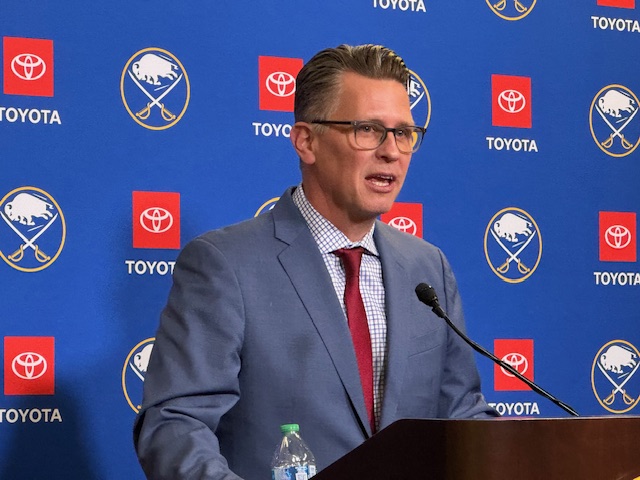
It’ll be up to Appert to put together schemes to change things up and it’s easy to get complacent when there’s a weapon like Thompson camped in the circle ready to blast it by the goalie. But too often it was easy to see teams shade heavily towards him to close off passes or take space away from Thompson and the plan never deviated away from trying to get the puck to him.
Trying to extrapolate how the Rochester Americans performed on the power play into how the Sabres will do is not a worthwhile use of time. However, throughout Appert’s time coaching the Americans, they’ve traditionally had one of the better power play units in the AHL, but it struggled this past season scoring at a 17.9 percent rate and ranked 10th in the 15-team Eastern Conference.
Some of the things noticeable in Rochester’s power play featured the presence of bodies in front of the net and the dogged pursuit of loose pucks by those players. And it’s not as if they were lacking in shooters with Jiri Kulich having a shot that’s NHL-quality from the circle and an innate ability to score on the power play. When he becomes a full-time NHL player, he will be a key factor on a power play unit.
New coaches are going to bring a lot of attention to how the team performs no matter what, but with how the Sabres offseason has played out the worry will be that Ruff and Appert will have the weight of the world on them to fix it all instantly. Pressure is part of the job, but has Adams put them in position to succeed right away? Well…
Roster
Let’s start with the list of players the Sabres added and those who were on NHL contracts they’ve lost:
Added: Jason Zucker (FA-Nashville), Ryan McLeod (Trade-Edmonton), Sam Lafferty (FA-Vancouver), Beck Malenstyn (Trade-Washington), Nicolas Aube-Kubel (FA-Washington), James Reimer (FA-Detroit), Dennis Gilbert (FA-Calgary), Tyler Tullio (Trade-Edmonton), Josh Dunne (FA-Columbus), Mason Jobst (FA-Rochester), Konsta Helenius (Draft; 14th overall)
Lost: Jeff Skinner (Buyout; Signed by Edmonton), Matthew Savoie (Traded to Edmonton), Victor Olofsson (Vegas), Zemgus Girgensons (Tampa Bay), Eric Comrie (Winnipeg), Eric Robinson (Carolina), Tyson Jost (Carolina), Riley Stillman (Carolina), Joseph Cecconi (Minnesota), Jeremy Davies (Ottawa), Brandon Biro (Seattle), Linus Weissbach (Frölunda – SHL)
Re-signed: Henri Jokiharju (one year, $3.1 million); Ukko-Pekka Luukkonen (five years, $23.75 million)
Un-signed: Peyton Krebs (RFA)
One of the goals going into the offseason was to add top six help given the subtraction of Skinner from the lineup and the money that would’ve ideally added to the spending budget. That Skinner wound up lower in the lineup towards the end of the season should’ve served notice enough that things could change, but ultimately when he was bought out the question centered around who would come into the lineup to replace that production.
For as poorly as Skinner played during a lot of the season, he still produced 24 goals, third most on the team behind Tage Thompson and JJ Peterka. They didn’t make a trade to acquire an equal talent, but they signed Zucker who figures to be in a ‘tweener role that Skinner would’ve been in (and hated) had he stayed.
Zucker will either play on the second or third line (most likely) and his speed and veteran knowhow will be key in how Ruff will want the Sabres to attack the game using speed and pressure on the forecheck. Zucker has scored 20-or-more goals six times in his career, doing it most recently in 2022-2023 when he had 27 goals with Pittsburgh. If he gets back to that level of scoring, that’s a huge win, but at 32 years old, we’ll see how it goes.
A guy who could play second or third line minutes and could score 20-to-30 goals (or 15-to-20-goals) doesn’t offer much in the way of reassurance to address the offense in the top six.
This season would be an optimal one for Jiri Kulich to make the leap and make it impossible to send him back to Rochester, but the view on him from within the organization, particularly from Rochester assistant coach Vinny Prospal, is he’s meant to be a center, and that position is all kinds of funky right now. Kulich also has to be play at a top gear night in and night out.
“(Kulich) is a great kid; he’s a great player at that level, but he needs to (stay) consistent,” Prospal said in July. “He needs to tear up the league a little bit down there and to show that he’s an NHL hockey player. I mean, he’s got a great skating ability. He’s got a great shot. It’s just there cannot be dips in his play. He… fully made tremendous strides in his two-way game. When he was not scoring, he was doing all those things even on the ‘D’ side and that’s a credit to him. He can also improve the faceoffs and maybe become a penalty killer and stuff like that; be a more well-rounded player. But he’s definitely on the right path, and is he a NHL player right now? I don’t know. So, maybe he’ll come in here and tear it apart and he’ll grab a spot.”
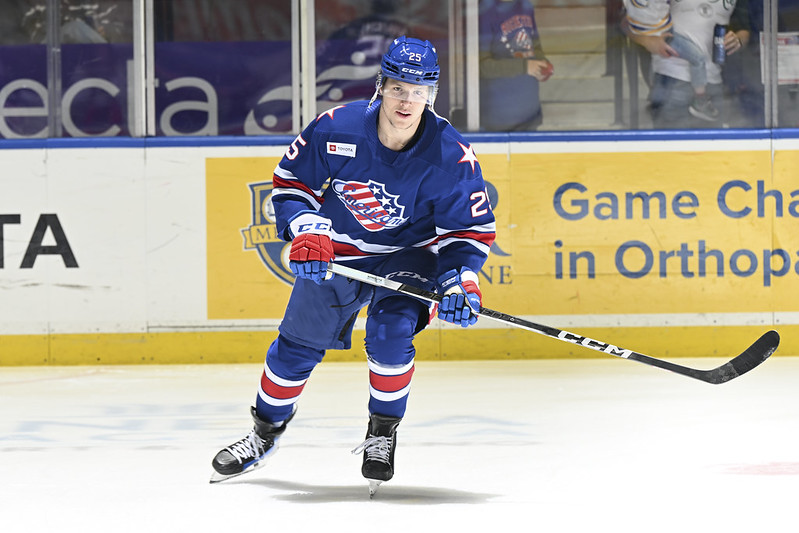
The hope that’s attached to Kulich, and to a lesser extent Rosén, is understandable because they’ve shown there’s real talent there. Kulich has proven he can score with the kind of ease in the AHL that’s rare to find, period, never mind with a guy as young as he is.
But the worry for the Sabres here is that a lot of what they need to accomplish this season requires a lot of “ifs” to become truths.
If Tage Thompson scores 40, they’ll be better.
If Dylan Cozens scores 30-or-more again, they’ll be better.
If Alex Tuch can score 30 again, they’ll be better.
If the power play improves, they’ll be better.
To be fair, every season for every team comes with questions like these, but the issue for Buffalo is they’re going into a season where they have to make the playoffs and are doing it with a new coach and new system and are essentially doing it while walking a high wire without a net.
No team can go into a season having any and all potential weaknesses covered with a backup plan that’s foolproof. But the Sabres have a roster where, if what we saw from their top scorers last season is closer to normal than what we saw two years ago, that’s a big problem and without better support, they’re in big trouble.
This is offseason doomerism talk for some, but these are also situations that bear watching because their success depends on it. But this also highlights the importance of Ruff and Appert being able to get everything right immediately. That’s a bit of a collar-tug kind of setup. And it’s also a bit unfair to put all of that pressure on them, but if/when difficult times pop up, the idea of pulling the top guys out of Rochester and into the NHL and having success with them is a great idea. Needing it to be great in execution when/if the time calls for them is much more daunting.
This is where the lack of any action to replace Skinner or add to the higher end of the forward group at all will loom ominously. At a time when the Sabres are in need of answers to be as close to concrete truths as they can be, their future hangs in the balance over ifs, buts, and maybes.
If they improve enough to be a 95-100-point team and miss the playoffs still, that will be met with lessened apathy but apathy nonetheless, but it’ll be enough to make everyone around the team buy into what they’re doing being the right thing. But another season with fewer than 90 points could make next summer look like a copy of previous offseasons from the past 10-plus years.
Adams and company believe in what they have and what they’re doing, but the stakes are sky-high all around. They have to be right about it or else things will get uncomfortable for everyone all over again.