

The way the Americans are finding success in the playoffs shows skill, resolve, and the ability to overcome obstacles.
TORONTO — History hasn’t smiled upon the Rochester Americans too often over the past 20 years. Playoff wins were hard to come by and occasionally so were postseason appearances.
Until last season, the Americans hadn’t escaped the first round of the playoffs since 2004-2005 and that was a team that featured Ryan Miller, Thomas Vanek, Jason Pominville, and Derek Roy among many others who went on to the NHL. Rochester hasn’t been loaded like that in a long time, but that team was stacked thanks to the NHL Owners’ lockout that wiped out an entire season.
But last season’s team highlighted by Jack Quinn and JJ Peterka got the Americans off the first round schneid and now this year’s team that features the likes of Jiri Kulich and Isak Rosén among others is building upon that.
Watching this team closely in the postseason has highlighted a few of the reasons why these Americans are different and it’s not just because some of their youngest players are among their best. It runs deeper than that even if how it’s executed seems straightforward.
What we’ve seen from them is worth highlighting and why what’s working for them could carry them further.
The content below was originally paywalled.
Special teams are always going to be discussed constantly in the postseason. The quality of the power play units and the penalty kill groups sticks out easily because those are instantly huge moments in any playoff game. Look at the NHL with how the Edmonton Oilers have made Los Angeles and Vegas pay for their sins with the best power play the league has seen.
Teams always want to limit mistakes and penalties are the mistakes that can break a game and Rochester has made Syracuse and now Toronto wish they’d not run afoul of the rulebook. Through six playoff games, the Americans are 7-for-21 on the power play. Scoring on one-third of your opportunities is extremely good and this is where their youngest players have thrived.
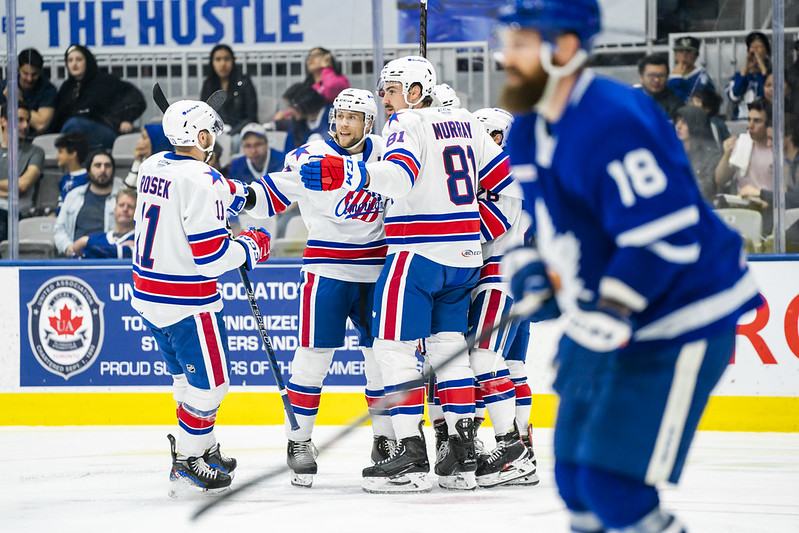
Of those seven goals, Jiri Kulich has three of them and Rosén has two. Kulich missed the first two games of the series against Syracuse, but he’s scored a goal in each of the next four games. Both of Rosén’s playoff goals are on the power play, and his goal on Thursday night was a current classic kind of tally. He was posted up in the circle and unleashed a one-timer in which Marlies goalie Erik Källgren didn’t stand a chance of stopping.
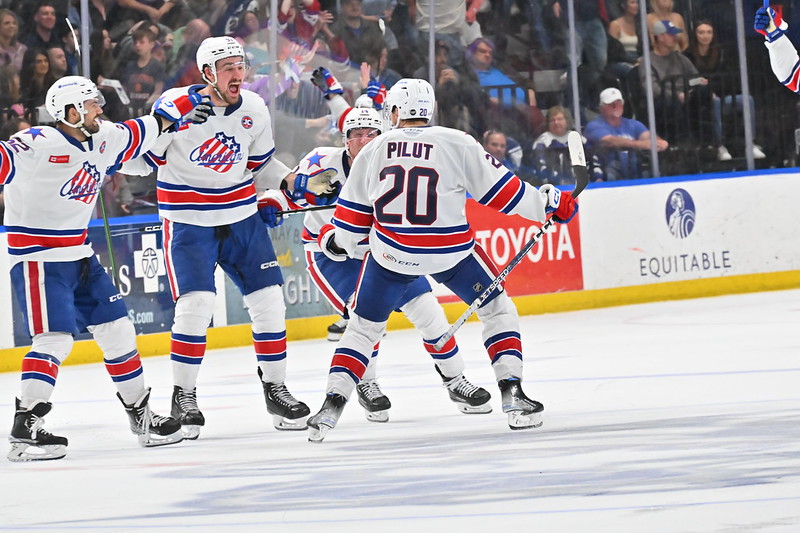
It was a Lawrence Pilut power play goal in overtime that sent them to the Northern Division Final as well. Making teams rue committing penalties helps add a psychological stress to their games. When you’re having that kind of success with the man advantage it can be a game changer.
It’s not just the power play that’s done well, their penalty kill has been very good, too. They’ve killed 80 percent of the power plays they’ve faced and while they’ve allowed four goals in 20 PKs, they’ve also scored two shorthanded goals. Kohen Olischefski’s shorthanded goal on a 2-on-1 with Mason Jobst completely deflated Toronto after they’d gotten out to an early 1-0 lead. Jobst has the other shorthanded goal which came in the wild 8-5 win against Syracuse in Game 3 of that series.
Jobst in particular has stood out, which is remarkable on its own because he’s listed at 5-foot-8, 185 pounds. What he lacks in size he’s made up for it with tenacity on the forecheck and the ability to frustrate puck carriers by being right on top of them all over the ice or taking away passing lanes with his stick.
“He’s an elite competitor that’s strong on the puck and wins a lot of puck battles and then has the skill to make plays with good players,” Americans coach Seth Appert said. “So, he might not have the skill set of a Kulich or somebody like that, but he has enough skill to play with other elite players and to make plays with them.”
Jobst is on an AHL contract and with the way he plays it makes you wonder if either the Sabres or another NHL team might think he’s worthy of an NHL deal. Jobst’s kind of forechecking is something other Americans teammates are also exhibiting the same.
Linus Weissbach has been a terror going after defensemen trying to bring the puck up the ice both at even strength and especially when they’re on the power play. Weissbach’s aggressive up-ice penalty killing gave Syracuse fits and did so again in Game 1 against Toronto before he left the game after the second period with an injury.
Power forward Brett Murray is also causing problems for opponents. His physical play is well known because being 6-foot-5, 227 pounds makes that possible (and punishing) but he’s shown great ability to get up ice on puck carriers and using his long reach to disrupt the carries and even steal the puck off their stick. Murray got a taste of NHL action last year and had career highs in goals (23) and points (49) this season.
Offense, big hits, and fights get all the attention, but his rounded out defensive game is earning him praise.
“I thought Murray was one of the guys that that willed our way back into the last series,” Appert said. “He wasn’t what we need him to be in games one and two, and he was an absolute beast in games three, four and five, and had a couple of fights and manhandled people and created turnovers and created hard offense just like that. Hit, turnover, go to the blue paint, get a tip. That’s a Brett Murray special.”
The Brett Murray special is how he scored in Game 1 on Thursday.
He put Marlies forward Pontus Holmberg on his seat during a puck battle along the wall and then made his way to the front of the net where he tipped Ethan Prow’s shot for a goal.
“That’s kind of my style play that’s going to continue to give me success at this level and hopefully the next level too,” Murray said. “It’s kind of what’s been getting me contracts over and over is that physical style play, being able to create turnovers, and get the puck to my linemates.”
Oddly enough, the Americans’ win against Toronto in Game 1 was their first win against Toronto in the playoffs, period. They were 0-9 against the Marlies after being swept in three previous meetings in 2011-2012, 2012-2013, and 2018-2019. Things are different with this group of Americans, just as it was last season when they made it to the second round for the first time since 2004-2005.
Wins like these are psychological lifts like that that can spur a team on to bigger and better things. History isn’t necessarily around their necks, but the fans are aware of it and that can be enough to make it their reality, too.
They’re ahead of last year’s team that was swept by Laval already, but they’ll need two more wins to make it as far as the 2003-2004 team did. But they know, getting ahead in a series doesn’t clinch anything. After coming back from down 2-0 to Syracuse to win in five games, one win is just one step in the right direction.