

Between Devon Levi, Jiri Kulich, Isak Rosén, and Ryan Johnson the next wave was already strong, but with Noah Östlund and Anton Wahlberg on hand, they’re even better.
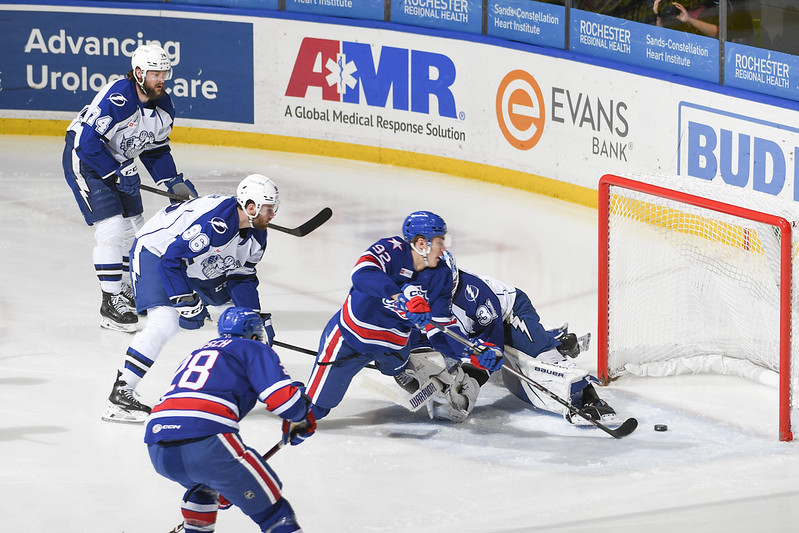
The AHL Calder Cup Playoffs are always a fascinating time. You’ve got teams that are a mix of wily and haggard veterans, hopeful prospects, and then the other prospects who just arrived either back from the NHL, from their junior or college teams, or out of Europe.
Every time you think you know a team, there are new wrinkles mixed into the makeup of a roster all throughout the lineup.
The way attention has been paid to the Rochester Americans since Kevyn Adams and Jason Karmanos took over not just building out their well of young talent but also putting a veteran group together to make sure it all weaves together cohesively, the results have been brilliant.
Advancing to the playoffs has become a regular, and expected, occurrence and last season saw a very young team advance to the Eastern Conference Final. That team was highlighted by then 18-year-old Jiri Kulich dazzling with his shot and power play acumen. A seemingly undersized Isak Rosén showed skill, smarts, and incredible resilience to take blows from the heaviest hitters from opponents and just keep going.
Two seasons ago, it was JJ Peterka and Jack Quinn who starred for Rochester in taking them to the postseason even though some tough lessons were learned by all after falling short in the playoffs.
This season, it’s no different. Some of the names are the same. Kulich and Rosén are helping to lead the attack once again. Rosén was co-leader in scoring with Mason Jobst posting 50 points. Kulich led the way in goals with 27 and was right behind Jobst and Rosén with 45 points. But wait, there’s more.
Devon Levi spent most of the second half of the season in Rochester and it turned out to be a very good thing for himself and certainly for the Americans.
Levi went 16-6-4 in 26 games with a .927 save percentage. He finished with the second best save percentage in the AHL behind Hershey’s Hunter Shepard who posted a .929. Considering the vast difference in styles between Hershey and Rochester, it highlights just how good he’s been and had to be.
When you add 20-year-old Östlund and 18-year-old Wahlberg, both fresh over from the Swedish Hockey League and both of them make an impact in Game 1 of the playoffs (along with Rosén who had the game-winner), it’s showing that the mix of veteran know-how and high-end youthful talent makes things work.
“There’s a reason they got drafted where they got drafted, but they’re young,” Americans coach Seth Appert said after Game 1 against Syracuse. “As young as we are, that made us a lot younger, right? Certainly, that’s where you lean a lot more on Jobst and Mersch and (Brandon) Biro and guys like that, some of the guys that have some experience in our lineup right now.
“But they offer us talent, they offer us competitiveness. They’re both very, very competitive players. They’re not a physically ready to be physically demanding players right now. But I thought Wahlberg has really embraced the physicality in North America.”
The content below was originally paywalled.
Wahlberg arrived in Rochester at the conclusion of Malmö’s season in Sweden. At 18 years old playing in a men’s league, he had five goals and five assists in 43 games. Wahlberg said he played about 16 or 17 minutes a game and even got time on the power play. The pace in the European leagues is a bit slower than it is in North America thanks to the large ice. There’s a lot more cycling and patience in the zone with the puck compared to over here. The smaller ice over here makes things a lot more chaotic as well.
But in nine regular season games with the Americans, Wahlberg had a goal and three assists and was put on a line with Rochester’s team MVP Jobst and team captain Mersch. In Mersch, Wahlberg has a player to show him the sort of game they’d like to see him adopt when he’s in North America full-time. Mersch crashes the net, uses his body effectively to mix things up and get position down low to create goals and havoc around the net. Add in how important Mersch has been as leader of the welcome wagon to all the new guys that have gone through Rochester, and it makes for an ideal setup.
“He likes contact, he likes forechecking,” Appert said recently about him “He’s north based. He wants to play a north, direct game. He wants to go to the net. But what I really like as he gets the offensive zone, he’s thinking more right to the net. Him and Merschy and Jobst have been a line so sometimes that means we have two at the net with him and Mersch and that’s fine. I’d rather have two people at the net than nobody at the net so I’m completely comfortable with that.
“He wants to be in hard areas, and he’s got a really good stick. His stick dexterity and ability to pull pucks off the wall in the breakout and in the o-zone is pretty impressive for an 18-year-old and that allows them to get out of some of those tight areas. He needs a lot of strength though. He’s still a little gangly, there’s still some Bambi-ish moments, but we’re really excited about him—ever since we drafted him, we got excited—but what he’s shown me in these first sets of games has been impressive.”
Wahlberg was drafted as a center and that is the position he prefers, but he said he’ll play wherever they want him to because he just wants to be on the ice and getting things done. That means taking charge and getting to the net.
“I need to do it, I’m a big guy,” Wahlberg said with a smile. “It always isn’t the best; you get cross-checked in front of the net. But good things happen in front of the net, so yeah, I’m trying to be there and do my best in front of the net.”
Even though he took some lumps in the first few games, in Game 1 he showed he’s not just a net crasher. He handled the puck coming up the wall and toe-dragged past a Syracuse defender on the way to the net where he used his size and reach to tuck the puck past Crunch goalie Brandon Halverson. It was a high skill play for a guy that’s not necessarily expected to do that.
“No, I’ve never seen that before,” Östlund said about Wahlberg’s goal. Those two were teammates for Sweden at the World Junior Championships so there’s some added familiarity for the two of them in Rochester. In Östlund’s case, he stopped by Rochester last season when Djurgårdens season ended, but he was injured and didn’t get to play in any games. While that experience was good for him, playing in games is what leaves a mark and, fortunately, he’s been able to do that this year.
After Växjö’s season was ended, Östlund joined the Americans playing in two of the final games of the regular season. He recorded one assists, but in Game 1 against Syracuse, he notched a power play goal to help rescue a miserable performance by their man advantage to that point. The goal was a rocket, but Östlund showed a ton of confidence in his offensive game.
Östlund, who is normally a center, played on the wing with Kulich and Rosén and his offensive abilities shined playing with, arguably, Rochester’s two most talented offensive players. There was one play in particular which Östlund was able to push the Crunch defenders back off of him by making a move with the puck and swiveling to give himself room. That play drew attention of the Crunch defense and opened up Kulich on his off wing. Östlund deftly made a pass to Kulich for a one-timer, but Halverson was able to make the stop.
It’s a small play on a rush into the offensive zone that created a scoring chance that didn’t result in a goal, but it was the kind of play that showed why Östlund is so highly thought of in the Sabres organization and why he was their other first-round pick, along with Kulich and Matt Savoie, in 2022.
“I think that’s what happens when you get that confident,” Östlund said postgame. “I think that’s how I am as a player and how I want to play, too. It was a couple of good chances that could have created more offense for us.”
A player with Östlund’s ability walking into a playoff lineup helps make Appert’s job a little tougher come playoff time. Think back to last year’s Calder Cup Playoffs when Savoie’s WHL playoff run ended and he joined the Americans against Hershey. It had already been a long year for Savoie and jumping into the fire against a heavy-hitting and physical Bears lineup didn’t do him any favors.
In Östlund’s case, he showed a lot of the same resilience and competitiveness Rosén did a year ago when everyone in the AHL playoffs tried to get the best of him physically. Mix that in with his skill, smarts and puck handling, the thought of what kind of player he can be when he gets stronger and heavier is tantalizing.
“He’s not intimidated by physicality at all,” Appert said. “He just has to get used to the lack of time and space in North America. I think one thing he’s already made the adjustment—and he and I talked after game one—in North America, you have to take in more information before you get the puck than you do in Europe. In Europe, you can get the puck and slow it down and kind of navigate your way through or back because it’s a little more soccer-like. Where in North America, you need to scan and take in pre-information before you get the puck because a lot of times, once you get it, your time is eliminated.
“He’s smart enough and he’s already making that adjustment, you saw that (Friday night). So that allows him to find those plays. And at heart he’s a center, he’s a natural playmaking center. That’s a lot to ask just coming over to North America and our centers are pretty good right now. So that’s where we slotted him on the wing, but you can see those center tendencies in those moments.”
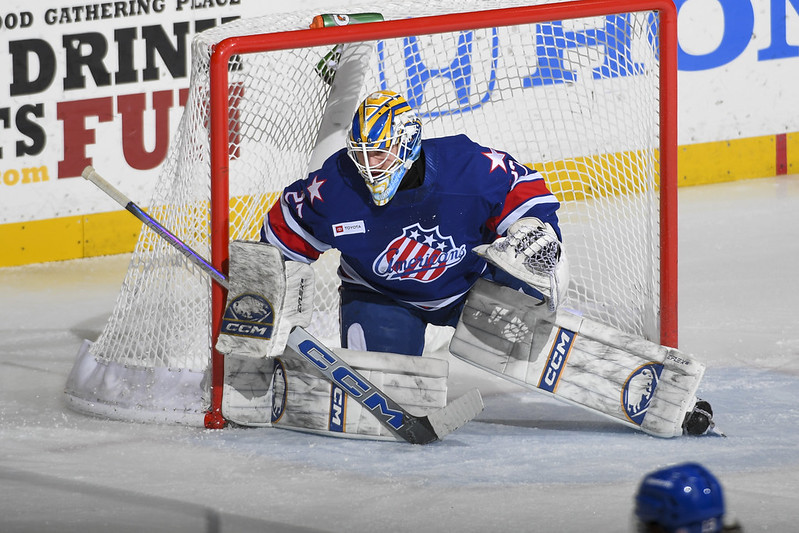
When it comes to Levi, it’s almost like we’ve gotten used to him being so strong in goal that he turns into an afterthought by accident. Make no mistake, however, he’s still very much at the forefront of reasons why Rochester can be so dangerous in the playoffs.
Levi’s season was frenetic going from starting the season in Buffalo and starting their first four games of the season before being sidelined briefly with an injury. There was also the part where he was still very green when it came to facing NHL competition. He showed brilliance at the end of last season after signing out of Northeastern and helped buoy the Sabres’ late-season last gasp attempt to make the playoffs. That and a strong preseason gave him an edge on the starting job out of training camp this year, but injury, inconsistent play, and the rise of Ukko-Pekka Luukkonen made it so Rochester was the right place for Levi.
He needed to play games and not back up every night and even though the Sabres were doom prepped for a goalie injury apocalypse, good sense won out eventually. And although the Americans were doing fine with the mix of Dustin Tokarski, Devin Cooley and Michael Houser, Levi’s taken everyone to a higher level. Even though he proved it all season long, he showed again in Friday’s playoff opener (and professional playoff debut) that he’ll take charge with his mix of elite talent and Zen approach. He made 35 saves including a pair of showstopper saves in the closing seconds to seal the win.
“Sometimes the game feels fast and that’s when you have to kind of slow it down as a goalie,” Levi said. “Sometimes the puck’s getting whipped back and forth and there’s a lot of screens and your vision’s being taken away. It’s important to slow the game down and not get too ahead of yourself and start over-pushing and moving everywhere. That was the focus, just kind of try to slow down, calm down, just be a steady anchor back there.”
It wasn’t a perfect game for Levi, but it showed a lot of what makes him so good. It’s the mental strength to forget about a bad goal from Daniel Walcott in the second period that came from a poor angle. How he was able to stay calm after Jordy Bellerive tied it in the third period. How he was able to make sure Syracuse didn’t get another one to force overtime.
“He was excellent, and the beauty was he gave up a bad goal and it didn’t faze him.” Appert said. “That’s what’s so impressive is being a young rookie goaltender in his first playoff games. And the save he made at the end, that’s his competitiveness, that’s his talent. That’s there. You know that’s always there. The composure, (to) not be shook at all after giving up a squeaker is probably more impressive in his first playoff game.”
That’s all part of the job for any goalie and it is why goalies are wired so differently than everyone else on the team. It all falls on their shoulders whether it’s their fault for a loss or their glory for a win or not. But Levi’s approach to the game and his own play comes from a place of common sense in a sport where bad luck or happenstance can derail the whole process.
“It’s (not) always going to be pretty,” Levi said. “I didn’t expect to come into this game and into this playoff run with everything going perfectly as planned. Obviously it’s a goal that, as a goalie, you want back, but that doesn’t change the fact that you still have a whole half a game to play. I think that the most important thing after that goal was leaving it in the past and moving forward, kind of restarting a little new segment of the game. Just bring it on, make the next save. I think if you’re carrying the weight of the goals that you got scored on in the game, the game starts to get heavy and it’s not fun anymore. So, just keeping it light, keeping it fun, enjoying the moment and just really playing for the team and for your teammates.”
While everything in Buffalo seems calm in goal at long last after the season Luukkonen had, but if the Sabres are going to be a playoff team next season and the years beyond that, having a duo of Luukkonen and Levi playing at their best and mimicking what the Boston Bruins have in Jeremy Swayman and Linus Ullmark, that’s something everyone would sign up to have. To have two goalies playing at Vezina-caliber levels is a luxury any team would love to have.
For now, the Americans are happy to be off to a good start in the playoffs. But for the players whose future is aimed for brighter spotlights and bigger games and moments, we’re getting a peek at why hopes are sky-high for the future of the Sabres.