

The Buffalo Sabres lost a very winnable 4-3 decision to the Anaheim Ducks due in part to their own misdeeds with the puck.
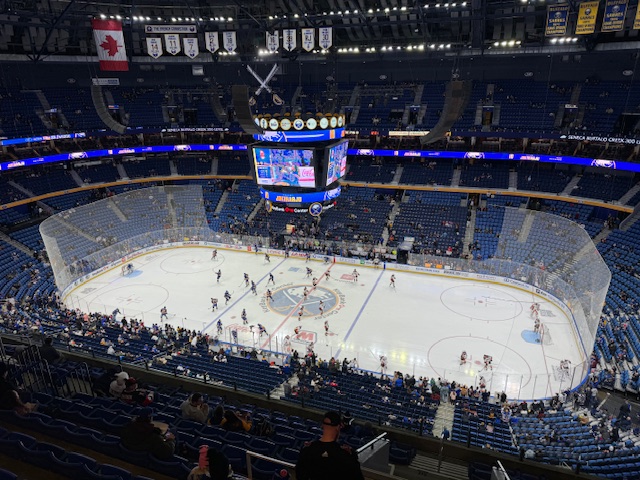
BUFFALO — Losing games isn’t acceptable for any team, but losing them when you’ve more or less outplayed your opponent and everything they got was gifted to them by your own team? That’s worse. Unfortunately for the Buffalo Sabres, it’s just another kind of defeat in which they both weren’t able to overcome what they did wrong but also weren’t able to cash in enough on what they did right.
The Sabres were swept in their two-game season series with the Anaheim Ducks after a 4-3 loss Monday afternoon. The Sabres had copious scoring chances, many of which were snuffed out by goalie John Gibson who played brilliantly, but many others that just didn’t result in goals. They were also undone by their own turnovers and misplays, some of which came from their own top players and veterans.
It was a game they could’ve very much had in hand 30 minutes in and yet it’s another one for the loss column, and this one against one of the NHL’s worst teams. Not that it matters who it was against, the errors made would’ve been cashed in by any team.
“There (were) many opportunities for separation,” Sabres coach Don Granato said. “We paid for the mistakes we made. It wasn’t a game where we were awful and made (a lot of mistakes). It just, we paid for the mistakes we made, and we couldn’t obviously – with enough generated from the chance standpoint – didn’t convert.”
Let’s soak in the disappointment of yet another missed opportunity with an unfortunately regular outcome.
The content below was originally paywalled.
To say this was a game the Sabres should’ve won is easy. They should have and it was apparent in the final numbers. Shots on goal were in their favor 37-15. Scoring chances at 5-on-5 were 30-13 in Buffalo’s favor and even high-danger opportunities were 12-6.
But that’s telling in itself. Of the 13 scoring chances the Ducks had, nearly half of them were on the Sabres doorstep. Whether it was:
The defensive breakdown that led to Adam Henrique scoring the Ducks first goal
Tage Thompson’s turnover and Erik Johnson not tying up Frank Vatrano when the puck leaked through Ukko-Pekka Luukkonen that became Vatrano’s first of two goals
Or Troy Terry putting one through Luukkonen right in front of the net as no defender even got a body on him before it was too late that proved to be the game-winner…
It was a semi-calamity of errors in a game which the Ducks didn’t have much in the way of sustained pressure or chances when the Sabres did have all of that.
“I think we were just sloppy with the puck,” Thompson said. “Obviously, I had a bad turnover that cost us and all the goals we got were just gifts that we gave them. They didn’t really have to work for anything. We just gave them free chances, free opportunities and you can’t do that. They’re a very skilled team, so give them free skills like that and they’re going to make you pay.”
Anaheim is a bad team in the NHL, but they’re not a bad team in the grand scheme of life so there’s that. Besides, in the Sabres two games against the Ducks this season they’ve made them look a lot better than their record shows. Monday’s game wasn’t exactly like that, although Gibson certainly looked all-worldly in his play stopping breakaways by Thompson and Jordan Greenway and making an unreal goal-line save on Thompson late in the third period to preserve the 4-3 advantage.
“I forget to talk about him sometimes because he just is like that every night for us,” Terry said. “He really is the backbone of our team. Some games you almost take it for granted and we hang him out to dry. It’s our job to give him as much support as we can. And, some of the saves he made tonight were just outrageous.”
What’s more disappointing in losses like this for Buffalo is they are doing good things. They are doing a lot of things better than they did last season. They are doing things that will benefit them in the long run. The problem with that is how all of it is playing out right now in front of us with the inconsistency and the frustrations they’re going through cyclically within a season.
“I think we’ve been playing better defensively overall, but that’s kind of the way it’s going this year,” Kyle Okposo said. “When you’re not scoring, you have to make sure you’re doing all of the other little things correctly. And tonight, that’s what bit us – just those little details of the game that weren’t good enough.”
Through 55 games a year ago, the Sabres scored 201 goals and allowed 187. This year, they’ve scored 161 and allowed 170. It doesn’t take a math whiz to see the differences between the two, but they’ve got eight fewer points this season than last year at this time (60 to 52). We know the scoring has been their biggest problem and the power play is the biggest source of their troubles. It’s just incredibly tough to see a team full of (still) young players having to learn lessons about what it takes to succeed in the NHL game-to-game.
“This is a process so they’re in the process of learning is the obvious,” Granato said. “You would hope they would have learned, right? And you hope, and I can remember us talking last year, you can’t forecast. I’m not in the forecasting business because you wanted me to forecast back then and there’s too many elements throughout the league, injuries being one of them, and there’s just too many elements and you’re in the middle of this process and our responsibility is to make sure we’re, again, we’re getting better so we get through this we’re going to be able to have a better product by going through any adversity, any challenge. And the good indicator for us is we’re getting better in the areas we’ve targeted to get better in from last year…
“The numbers show what’s not there is what we know this team, and what we’ve come to know this team, can be very good at: scoring. Right? It’s all going to come back at some point and the foundation is going to be stronger.”
The pressure and the expectations have been there all season long and, yes, everyone to different degrees has handled it in various ways. In some players’ cases they’ve done so by coming back sooner than expected from injury to try and right the ship. Others have fought it hard all year to try and get things going only to grow more frustrated when it hasn’t to their liking. The results of all that have been as expected and that’s deeply unfortunate.
“(The pressure) will never go away,” Granato said. “It’s never going away; it’s going to be right at the edge all the time… It’s part of the game is more pressure, more pressure and how do players operate under it. That’s never going to go away. I think you’ve got to manage it better than the team you’re playing against. And tonight, as an example, you’ve got to score more. You generated enough to score and outscore them and win that game. So, we can divide that game up 50 different ways, the fact is you had more than enough opportunity to win that game just generating your scoring chances. Teams that win Stanley Cups, they outscore their mistakes. It’s not that they don’t make mistakes, it’s not that they don’t feel pressure—turn pucks over, make poor decisions—they don’t score.”
Goals drying up due to myriad issues will be what ultimately goes on the Sabres tombstone once the season ends, but figuring out ways to get those back, be it through psychological conditioning or figuring out how to get things on the ice in a different place to help make that happen, something’s got to happen to help move that along and make it the foremost issue to handle as soon as possible.
The Sabres are in the top-10 in goals at 5-on-5. They’re right there with the likes of the Boston Bruins, Toronto Maple Leafs, and Detroit Red Wings—all playoff teams in their own division. They’re even right there with Edmonton and Vegas in 5-on-5 production. It feels almost unbelievable to see that, but that’s where they are.
Fixing the power play in the right way had to happen months ago, but it’s virtually too late to get things right to get them in the postseason now. Getting that figured out to carry it over into next season would at least give this group something to build on rather than drowning in disappointment and the overwhelming negativity surrounding the organization that will only grow louder and more pointed with each loss to come.
You can ask, “it can’t get worse, can it,” and that the answer to that is always, “yes.”