

The Sabres snapped a three-game winless streak with a 4-3 shootout win against the red-hot Washington Capitals and made us view things in different ways.
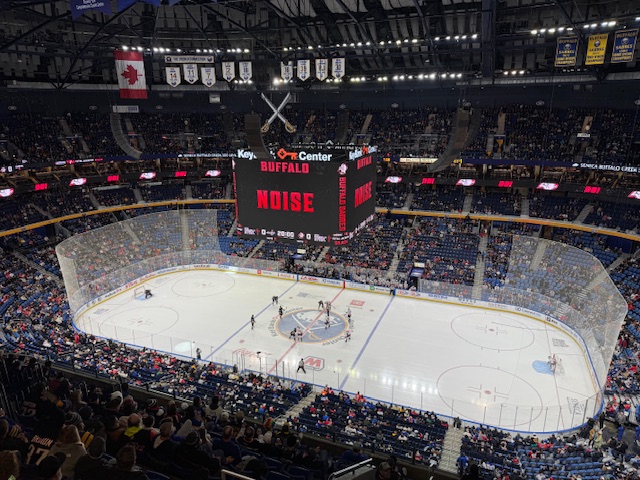
BUFFALO — One of the fears of the Buffalo Sabres returning home riding a three-game winless streak was that the streak would continue. After watching a losing streak snowball out of control in December to the tune of 13 games, it’s a natural reaction. Particularly since each streak began after a three-game win streak was snapped.
With the Washington Capitals, one of the NHL’s best teams, in town the feeling was ominous outside of the Sabres room. Fortunately for the players, they were able to put things together and not crack after losing the lead three times and pulled off a 4-3 shootout win and end the streak.
They don’t have to be pretty. They don’t have to be so sweaty. They just have to be wins from here on out.
“We know the goal,” Alex Tuch said. “We know how to do it. It hasn’t happened every single night. We’ve been able to find wins when we weren’t doing it. We’ve lost when we were playing the right way, too. So, a lot of games have been really close. Have gone both ways, obviously – have gone against us recently, especially during the 13-game span. But I think the work ethic that our group has shown in the past two or three weeks has been a lot better. I think the commitment to playing the right way, to better D-zone, to blocking shots, to sacrificing for one another, I think has been a lot better. It hasn’t been perfect by any means. It needs to be better, continue to get better.”
Sitting at the bottom of the standings in the Eastern Conference and beating the team perched at the top is something that should inspire the Sabres. The Capitals certainly weren’t happy with their game, but they can’t be perfect every night. No team can be and teams can’t be imperfect every game either.
Buffalo’s game on Monday wasn’t perfect, that’s for sure, but winning when imperfect has been difficult at times. Winning when not having an A-game against an elite team should be the kind of win that sparks a run.
“We got a great effort, we came out good,” Sabres coach Lindy Ruff said. “Obviously we responded almost every time they scored. We paid a big price for turning the puck over on that last goal, and then we got tired people on the ice. We’d actually done a really good job in our D-zone, but when you’ve got tired people, you’re not quick to cover, and it cost us the tying goal. But I do like the response in overtime. I mean, unbelievable goal by Tuchy to get us through the first three. And then our goaltender closed the door, and JJ, heck of a shot to win it for us.”
More from a win that, if things rebound in the second half of the season, could be one that signaled a turnaround.
The content below was originally paywalled.
As a rule, overrating a shootout win is something we try very hard not to do. Shootouts are for all intents and purposes toss-up games that either team had rights enough to win. And that was certainly the case on Monday night. It was an eye-of-the-beholder type of night.
You could view the Sabres getting an early lead on the first of two Alex Tuch goals when he (apparently) got a piece of J-J Peterka’s shot that beat Charlie Lindgren as a great sign again of how the team was able to get on the board first and seize control of the game.
“I think for us, just keeping things simple early,” Sabres forward Tage Thompson said. “I think that’s usually when we have a recipe for success is when we’re keeping things simple, moving pucks north, not bringing them back toward our own net. I think that gets us out to a good start for the most part against a lot of good teams. I think where we’ve caught ourselves in trouble is we get a lead and we start to feel good about our game and we start to hold onto pucks a little longer and try to make that extra play, and it comes back to get you. So, I think that’s something that we’re progressively getting better at as we move down the road here, something that we need to continue to get better at. All in all, I thought I really liked our game tonight.”
The Capitals looked good because they were able to bounce back three times after the Sabres grabbed one-goal leads. Twice it was Tom Wilson scoring to tie the game at 1-1 and 2-2. Aliaksei Protas did it with 4:13 to play in the third to make it 3-3 and send the game to overtime. That’s the kind of resilience good teams continually show and can use that to mentally wear out opponents. The whole, “Why don’t these guys just go away” sentiment. It’s that kind of behavior from opponents that’s caused the Sabres to fall apart in games, especially in third periods.
Buffalo was able to not let the Capitals’ resilience to get to them in this game. They got a 2-1 lead after Tuch’s second goal in the second period and after Wilson tied it at 2-2, Thompson’s power play goal—which he shot at 103.7 miles per-hour from the left circle—gave them a 3-2 lead they took into the third period.
The Sabres’ third period performance was the definition of “bend, don’t break.” The Capitals outshot them 10-4 in all situations and at 5-on-5 held a 17-3 advantage in shot attempts. Washington upped the pressure and if it weren’t for a couple of small mistakes during the shift in which Protas tied it, the Sabres could’ve skated out of there with a regulation win. We’re not going crown the Sabres for not giving away the game in the third, but the Caps 5-on-5 scoring chances were just 5-2 and high-danger chances were 2-1 in their favor.
Bend, don’t break.
“I think we’ve been in situations like that all season, so we’ve had a lot of experience to draw off,” Thompson said. “Obviously, those happen in the game sometimes, out of your control. It’s how you respond. I thought we did a good job responding all game just to all the little pushes they had. They’re a good team, so they had shifts where they were in our zone and got good looks, and I don’t think we let it affect us, and went right back to playing our game and kept it simple and direct and got rewarded for it tonight.”
Overtime when Alex Ovechkin is on the opposing team creates a terrifying set of circumstances. Having the guy who will soon be the NHL’s all-time leading goal scorer hitting the ice in a 3-on-3 situation is a nightmare scenario and watching how Caps coach Spencer Carbery deployed him was fascinating. Ovechkin is 39 years old and asking him to haul ass up and down the ice for the majority of an overtime period is asking a lot and he played only 1:21 of the extra period.
Ovechkin was sent out there when the Caps established time in the attack zone, and it allowed him to stay fresher to circle through the zone and attempt to get open to shoot. You don’t need to have him sweating it out trying to cover everyone all over the ice, you want him out there to end the game with a goal. To the Sabres credit, they did well all game long to have someone in his face and despite getting five shots on goal, he wasn’t the classic threat every shift he tends to be against them.
Ovechkin did nearly set up the Sabres for a game-winner when he had a brutal turnover in the neutral zone that Jason Zucker grabbed for a breakaway opportunity that Lindgren was able to snuff out and helped send the game to the shootout. In the shootout, Tuch and Peterka led the way scoring for Buffalo while Ukko-Pekka Luukkonen stopped the Capitals final three shooters after Pierre-Luc Dubois scored on the first attempt. After holding the Caps off all game, it was the Sabres coming back to win in the end via penalty shots.
The wins don’t have to be pretty; they just have to be wins.
“It’s been a lot about trying to insert some confidence in players that, at times, were feeling a lot of stress,” Ruff said. “Same stress that coaches feel, but they’re on the ice playing. And when that many bad things happen, they’re looking to places for answers. They’re looking for us to help with the answers. We’ve changed quite a few things about the way we play. I think it’s helped our team. I think we’re getting pretty confident now about what we want to do with the puck. Our puck support has been a lot better, and I think we’re on our way out of it.”
The Sabres are still at the bottom of the standings in the Eastern Conference, but with the way the East has been since the get-go, no one is really out of contention. The win got Buffalo back to within six points of the second wild card spot and while they’ve got seven teams between them and that position, the doom that welcomed them back home from Las Vegas in the throes of a three-game losing skid was dissipated for the time being.
“It should drive all of us, to know you’re that close,” Ruff said. “When you go through what we went through, we should come out of this a better team. Everybody should come out as a better player and understand how hard it is to win games and sometimes how easy it is to lose them. And I think that we’ve got some players that are growing, that understand now that no easy game, and there’s no easy play. We’re fortunate that, the way everything has unfolded, we’re within striking distance with [41] games left.”
Forward Jiri Kulich played just 5:18 on Monday and left the game with what Ruff said was a lower-body injury. You hope it’s not anything serious for all of the reasons, but with the way he’s played the past few weeks and the confidence that’s grown in his game, an injury setback would be a difficult setback.
Henri Jokiharju returned to the ice after he was a healthy scratch the past six games but missed a chunk of time in the second period to get repairs and when he returned, he had a full face-shield on his helmet. Didn’t catch what happened to him and we, uh, don’t exactly have a view of the broadcast in the press box. We can only assume he suffered an injury to the face. Yes, we’re aware of what happens when you assume.