

The Sabres were quick to alter the lineup after dropping their first two games, scratching Victor Olofsson for Tyson Jost and coming away with a 3-2 overtime win against division rival Tampa Bay.
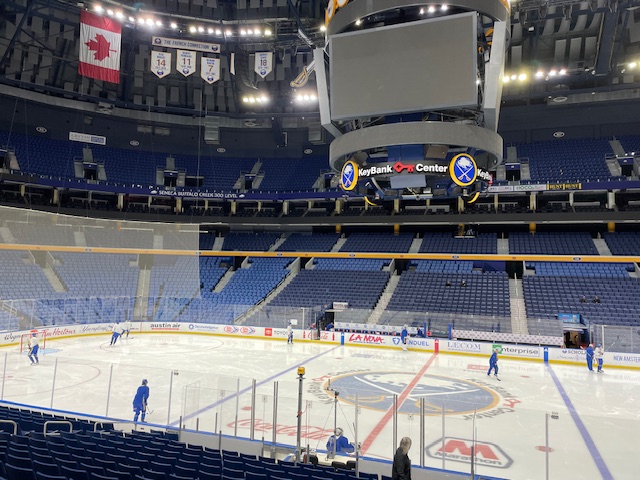
BUFFALO — The beginning of the NHL season is such a tricky dance to choreograph. Teams aren’t square with their systems, players are still getting into full game shape and working on getting the pacing down, and goalies are trying to get their own games settled while everything in front of them is in some kind of shambles.
It’s what makes the head coach’s job so difficult. Any coach would love to have their lineup stick together as long as possible and let them work the kinks out and get into a rhythm that carries them deep into the season.
That’s the hope, anyway. But sometimes the team starts 0-2-0 and there are distinct issues at play that need to be addressed. Such was the case for the Sabres. The hard luck they had losing to the Rangers in the season opener was followed by a much better performance that went unrewarded on Long Island and was befouled by bad luck and iffy judgments by officials. These things happen, but as far as things under their control went, they had distinct problems with a pair of their scoring lines.
The trio of JJ Peterka-Dylan Cozens-Victor Olofsson struggled terribly and that trickled down into the Zemgus Girgensons-Peyton Krebs-Kyle Okposo trio as well. Olofsson reverted back to the form we saw for a lot of last season, and that caused the line to struggle. The Girgensons-Krebs-Okposo line wasn’t able to turn the tide with their energy in either game even though Krebs, by the eye test, performed very well.
That combo led to these line changes against Tampa Bay on Tuesday:
JJ Peterka—Dylan Cozens—Peyton Krebs
Zemgus Girgensons—Tyson Jost—Kyle Okposo
With Olofsson back in the press box for a night, the fans got their wish and with Krebs back on the wing (mostly) and splitting handedness on faceoffs with Cozens, the fans also got their line wish as well.
Ultimately, the Sabres got their first win of the season 3-2 in overtime thanks to Dylan Cozens’ scorcher past old friend Jonas Johansson. There was an injury scare with Mattias Samuelsson who left after one shift in the third period, but Don Granato said he’s day-to-day and didn’t seem so concerned about it. It wasn’t a game lacking in drama, but how did it work out with the line changes? Let’s chew on the extreme small sample sizes and try to digest it all.
The content below was originally paywalled.
For a team whose goal is to get to the postseason and in a game against a division rival that’s also tripped up out of the gate, it was a stunningly necessary game for both teams to win to try and calm things down just a little bit.
The Lightning were closing out an early-season road trip while the Sabres were kicking off a four-game homestand. Home ice wasn’t kind to them last season and with the next week full of games at home and a loss at KeyBank Center already on the record, eating another “L” was going to make things needlessly anxious three games into the year.
Fortunately for Buffalo, they won’t have to do that. They will have to wrestle with giving up a point to the Lightning thanks to Brandon Hagel’s second goal of the game that tied it up with 7.0 seconds left, but those are worries for some other time if they’re meant to be worries at all.
The easy things to notice
Jost’s impact on his line was immediately noticeable after he sprung Girgensons for a break-in that turned into his first goal of the season. Girgensons wired a shot from the circle glove-high past Johansson to give Buffalo an early 1-0 lead. It was an excellent heads-up play by Jost, and a smart read from Girgensons to make it happen.
“Josty just got a puck and I saw an opening and saw no one was there, so I took off and he hit me with a nice pass and I kind of let it rip,” Girgensons said.
As for Krebs, he played 14:30 for the game but was getting specialized usage in the third period when they were in need of faceoff wins. He was a minus-1 in plus/minus (whatever) and had no points. His line with Cozens and Peterka had a couple of chances early on, but their rotations together slowed a little bit in the third period with Buffalo hanging onto a lead. The eye test for the three of them together didn’t amount to too much, but it was in how Granato was specifically deploying Krebs throughout the latter stages of the game that stood out.
Krebs won eight of 12 faceoffs on a night where the Sabres actually had the advantage on draws at 52 percent (27-for-52). I know, I know…faceoffs don’t matter but specific ones in certain situations do and that’s when Krebs was being pressed into action later on.
“I thought Peyton had a great game,” Granato said. “We used him, as you saw, late in that third period in defensive zone draws, and he was really good there, even with different lines. He brought that energy, tenacity, and structure really. He was good.”
The deeper numbers
Per Natural Stat Trick, that trio was credited with 6:22 ice time together at 5-on-5 in which they had eight shot attempts for and four against (66.67 CF%) and had 71.87% expected goals for. They were also credited with four scoring chances for and only one against. They played with jump, they forechecked well, and frustrated Tampa Bay puck carriers. A very solid game from those three.
“We’re in a process here and we’re trying to get better in the D zone,” Girgensons said. “As with everything else, there’s still a lot of things to improve, but I did like the effort and the way we came out.”
Compare those with what Krebs-Girgensons-Okposo did in the first two games knowing fully they played not-so-great against the Rangers and took 20-30 minutes to get it going against the Islanders. In 14:16 at 5-on-5 they had 11 attempts for and 18 against (37.9 CF%) and 20.7 xGF% with no goals for and two against.
Judging Krebs’ night with his new line tells part of the story.
The trio of Krebs-Cozens-Peterka played 7:48 at 5-on-5 and were credited with two shot attempts for and four against (33.3 CF%) and had 11.95 xGF%. Not great, obviously, but on the whole the Sabres had the bulk of their lineup playing much better. Juxtaposed against what Peterka and Cozens did with Victor Olofsson, however, highlights why the change was made.
In 22:45 at 5-on-5, Olofsson-Cozens-Peterka had 12 attempts for and 21 against (36.4 CF%) with a 27.3 xGF%. They were outscored 2-0 and out-chanced 10-3 in that time including four high-danger chances against compared to one generated.
Again, these are the smallest sample sizes possible but they’re also all we’ve got to work with here. Since the Sabres pulled out a win, there’s very little chance Granato will shuffle the lines up again. He’s not one to fix what isn’t broken, per se, and that forward setup got them their first win of the season.
It’ll bear watching how things progress with Krebs alongside Cozens and Peterka because everything Krebs does with his play and his details are good but that line needs a jolt offensively. They had a brilliant opportunity to pot one when Peterka and Cozens broke in on a 2-on-1 with Peterka having a great look at a shot, but he opted to pass to Cozens and the play was broken up. Being selfish is OK in that situation and that’s something Peterka will remember the next time, assuredly.
What’s perhaps more interesting in this win is how they were able to not let a late tying goal and the sinking feeling that causes carry over into overtime. Things nearly became cataclysmic when Alex Tuch lost an edge and then broke his stick in his own zone when trying to elude Nikita Kucherov, but he rebounded to make a nice play without his stick to literally kick the puck away from Kucherov and out of the zone. IF they can eliminate the roller coaster highs and lows in-game and between games, the maturity will carry them ahead to better things.