

In a game with two teams riding four-game losing streaks, something had to give and this time around it was the Sabres whose misery continues.
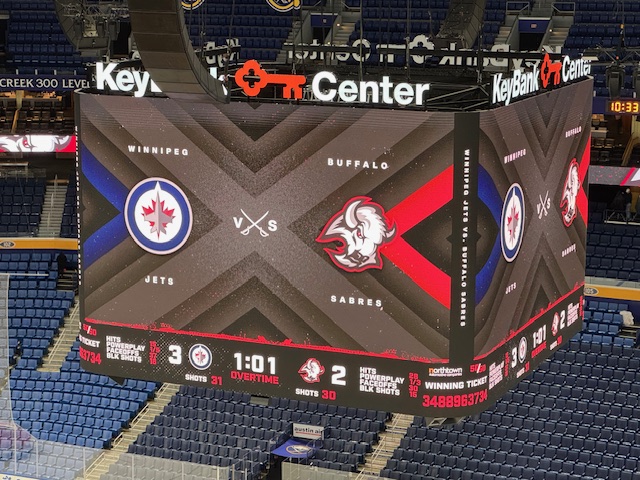
BUFFALO — When compared to Tuesday night’s disastrous defeat to the Colorado Avalanche, the Buffalo Sabres’ effort on Thursday was light years beyond the final 40 minutes of that game. And that’s a good thing because anything that resembled it in any way would be cause for investigation.
That’s what makes Thursday’s 3-2 overtime loss to the also-skidding Winnipeg Jets that much more frustrating. The Sabres were better than the Jets in a lot of ways and you could make a conspiracy-laden argument that they actually did beat them in regulation all things considered. After all, the Jets had a goal allowed despite a goalie interference challenge by Lindy Ruff and the Sabres had an apparent go-ahead goal early in the third period taken off the board by Scott Arniel’s similar challenge that was upheld.
Still, despite getting a point out of the effort, it still goes down as a loss and one point they won’t be able to recover and the loss of any points in games like these tends to come back and haunt teams, especially in a very busy playoff race in the Eastern Conference.
“It’s not what we wanted, but I feel like it was a good turnaround,” Ukko-Pekka Luukkonen said. “We defended well, boxing out, taking care of rebounds, so way better than last game.”
As harsh as the words were for the Sabres after the game Tuesday night, the effort in moving on past that and playing it forward on Thursday was noticeable all the same, particularly without captain Rasmus Dahlin on the blue line because of back spasms.
More ahead on a tough loss and the continuation of a losing skid.
The content below was originally paywalled.
You know the Sabres played well enough when the power play is what got the game jumpstarted for them. They got their first goal on the man advantage since Jason Zucker scored November 20 in Los Angeles when Tage Thompson wired a shot past Connor Hellebuyck to the top corner from the right faceoff dot. The Sabres had been 0-for on their previous 16 power plays and seeing Thompson score from a location that’s not his usual post-up spot gave the fans that turned out a positive jolt.
Unfortunately, that boost was short-lived because it was 47 seconds later the Jets tied it up on a Gabe Vilardi tip of a Haydn Fleury shot from the point. That kind of answer from the Jets is exactly what they needed to try and turn around their own four-game losing streak they entered the game with. Tip plays always seem like bad luck when they go against you, but they’re usually indicative of something else gone wrong.
“I didn’t like the first goal,” Ruff said. “We weren’t strong enough on the first goal. That guy should have never got to the front of the net. And that’s the area of the game we’re working on as a group. We can’t give up opportunities where they undercut us, get to the net front, and we can’t give up second opportunities, which can go uncontested like the other night.”
On that play, Bo Byram was late getting to Vilardi who snuck out to the front of the net for the deflection. Luukkonen immediately signaled to the referee he felt he was interfered with by Vilardi which led to Ruff challenging the call for goalie interference. After review, the goal was upheld, and the game was tied 1-1.
Winnipeg got the benefit of the review again early in the third period when Sabres rookie Tyson Kozak cleaned up a rebound of Connor Clifton’s shot. Kozak made his NHL debut in this game and that he thought he had his first goal to put the team ahead would’ve been a special moment. But NHL life is cruel and on this particular play, Beck Malenstyn skated through the top of the paint to get in Hellebuyck’s way. The Jets challenged the play and got the ruling they hoped for.
“I don’t know if there’s a smart way to say this, but I feel like it’s bullshit,” Luukkonen said. “There’s no way I can make a save on that. I’m not that far out from the crease. If they want to call that a good goal, I don’t see a difference – and then our guy gets pushed into him. I don’t know, it’s a quick game, it’s hard for the refs to make the right calls always, but I have no chance to make a save on that play. I don’t know if he has any other route to take there, I might be a little bit outside the crease, but I feel like that was kind of two similar plays and two different calls. In the end, they make the calls, we play and that’s how it went today.”
If there’s an issue to takeaway with how these challenges were judged, it’s that if a player cuts through the paint and makes contact with the goalie then you can bank on it coming off the board. That’s what happened with Malenstyn and Hellebuyck. Even with Brad Lambert pushing Malenstyn, his path wasn’t deviated by the contact. If anything, getting a “happy accident” there can help turn the call in the scoring team’s favor.
With Vilardi and Luukkonen, Vilardi never got into the paint and while he glances off of Luukkonen’s glove while he’s at the top of the crease, he was never in the paint. Mind you, these kinds of designations aren’t in the rule book for these plays, but the rule book has enough gray areas written into it for interpretation by officials. If that seems unfair, it’s understandable, but the NHL doesn’t go for hard black-and-white rulings unless it’s offside or dumping the puck over the glass. Even those have been less clear as time’s gone on.
But if it’s understood that if a player goes through the paint and hits a goalie it will be called back, then fine, that’s the way it is. Call it an unwritten but understood rule and that’s that. Allowing nuance into that equation is how things get to be inconsistent.
“You don’t know unless you challenge,” Ruff said. “It’s that kind of gray. You don’t know. I thought just the fact that he wasn’t allowed to make a save, that’s an interference penalty. It’s at least an interference penalty then. He knocked his hand down, that’s where the puck was going. You got to challenge that. They used he was out of he was out of the crease; the guy that went through was out of the crease. Does that mean the guy can run the goalie over because he’s out of the crease? No. So it’s always a hit and miss, but the only way you’ll know is challenge it, and you get it goes your way, it doesn’t go. I didn’t like the call. Didn’t like it either way. We had it go the other way on us and then went the right way for them.”
What’s odd about two sizable reviews like those is that while, yes, they were big factors in how the game played out, the entire process of the game itself was vastly more important to break down for Buffalo and when examining the advanced stats, they’re pretty good.
The Sabres played a much smarter, more effective game against Winnipeg. They were hard on pucks, they eliminated odd-man rushes, and their special teams were strong. If there’s an area to pick on it’s penalties because recklessness caught up to them again.
Early in the second period, Jacob Bryson gets a dubious penalty for interference in front of the net trying to clear Vilardi away. While on the delayed call, Thompson tripped up Mark Scheifele, an unmissable must-call penalty. It goes from a regular 5-on-4 for two minutes to a 5-on-3 for two minutes and with that much time, a goal against is inevitable. When it’s Kyle Connor shooting the puck, it’s even more difficult and his shot got through Luukkonen with 28 seconds left on the 5-on-3 to tie the game 2-2.
“Got stuck taking a couple of tough penalties,” Ruff said. “I can take a look at every call. I can take a look at some of the box-outs, like the box-out by 78, his guy went down. I can show you 10 of those in the game. And I’ve been harping on our team to be firm around the net and box your guy out. It’s like one of the first ones I’ve seen called. The Thompson penalty, that’s a penalty we can’t, you can’t make that a 5-on-3. You can’t do that. But there was a lot of good in the game.”
After all, the Sabres ended the first period with a 2-1 lead thanks to Thompson’s power play goal and Dylan Cozens tucking one in five-hole against Hellebuyck after a nice play by Zach Benson. But penalties evened the game up and despite the Sabres killing off four other ones, they didn’t stop all five.
Losing five in a row and going 0-3-2 during that span is very obviously not good and looking back on the losses, two of them are really bad (at the Islanders and Tuesday against Colorado) and the other three were well played games with unfortunate outcomes against Minnesota, Vancouver and now Winnipeg.
The last time the Sabres had a losing streak this long was November 2022 when they dropped eight in a row and took zero points out of any of those games in a season where they finished out of the postseason by one point. Fans don’t want solace, they want wins but getting at least a couple of points in these losses is something and that’s better than nothing even when it all feels like emptiness.
On the more upbeat end of things, defenseman Mattias Samuelsson and forward Jordan Greenway returned to practice on Thursday. With Dahlin out of action for an undetermined amount of time, getting Samuelsson back ideally will help soften the blow there. Dennis Gilbert got into the lineup with Dahlin out and fought Logan Stanley somewhat out of the blue in the first period. Both guys also got 10-minute misconducts to go with their fighting majors.
Kozak got into the lineup Thursday because Jack Quinn was a healthy scratch. Ruff, again, pointed out that they need results from him and highlighted how his one goal was an empty-net goal. He’s a player that needs to produce and he’s not doing that and he’s slipped back a bit into looking unsure of himself at times on the ice and that turns into problems.
Utah is up next on Saturday afternoon.