

Victor Olofsson was a healthy scratch Monday night in Toronto and while it was time for it to happen, it’s easy to sympathize with a player in his position.
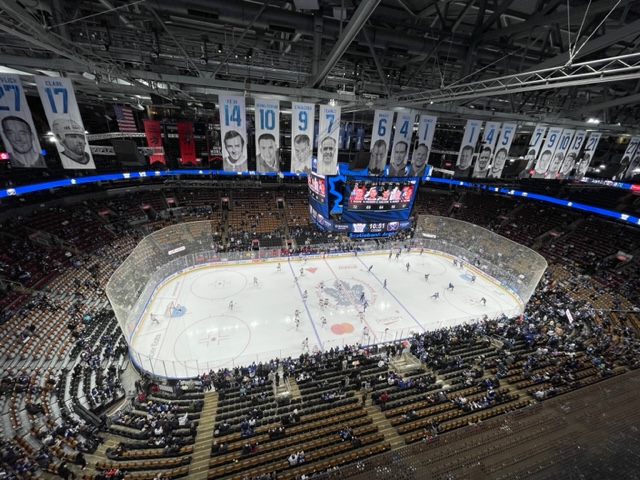
TORONTO — There’s a level of discomfort that can occur in sports when you get to know the athletes as regular people like you and I as opposed to players on the team I want to win. It’s important for us in this role to be able to have normal, everyday interactions with the players because otherwise it’s a very cold reality. One of mutual common use, a means to an end.
To best understand a player’s motivations that lie outside of winning games and championships you have to know them. Those kinds of reporter-athlete relationships can be difficult to form because, let’s face it, we’re all guarded in ways and athletes have plenty of reason to not want to open up in full to those of us writing about them. But even on the most basic level you each get to know each other and there can be levels of sympathy, or in some situations empathy, for the players.
Those kinds of feelings come out most often when the player has a close relative pass away or a terrible health diagnosis that reminds us that, yes, they are no different than you or I apart from their supreme ability in their sport. Breaking that down into the more common, maybe mundane, way and sympathizing for a player going through a slump or being frustrated with how they’re playing can be more difficult to identify with because we’ll never be professional athletes being paid a lot of money to play games at an elite level.
This brings us to Victor Olofsson.
The content below was originally paywalled.
When you look at the big picture of his season, it looks like a successful one, and it has been to a degree. He’s scored 24 goals and has nine assists, making him a prime “Cy Young” challenger among players whose main skill is scoring goals instead of setting them up. Being a 20+ goal scorer in the NHL is impressive and Olofsson’s skill, an elite shot capable of beating any goalie, makes him stand out among other players in the league.
His story is very cool. He was a seventh-round pick by the Sabres in 2014, the final round of the draft. He played four seasons in his native Sweden in the Swedish Hockey League. In his final season with Frolunda he led the SHL in goals with 27. He signed with the Sabres following that season and headed to North America in 2018 and in his one and only season in the AHL with the Rochester Americans, 2018-2019, he scored 30 goals with 33 assists (63 points) in 66 games. The next season he was in the NHL where he’s remained ever since. He’s scored 20 goals in a season three times in four NHL seasons with his current 24 being his career high.
Olofsson’s story is a great one. Not many players come out of the seventh round to play in the NHL, period, never mind being a multi-time 20-goal scorer. In each season if there was a fault in his game, it was addressed and corrected as the season wore on. His one season in Rochester and his first in Buffalo saw him pile up goals on the power play but struggled to score at even strength. As those seasons wore on, the goals started coming at 5-on-5 and he was a player opponents had to be wary of whenever he was on the ice.
That’s what has made this season so difficult to watch.
The high moments, when his wrist or slap shot that seemed placed with a laser site, are vintage Olofsson. His goals are electrifying and bolts out of the blue. But in his past 17 games, he’s scored one goal with three assists and that goal came in the 10-4 drubbing at the hands of the Dallas Stars. Since the start of 2023, he’s scored 11 goals and four assists in 31 games, a rate of 0.48 points per game. He’s at 0.51 per game this season which is the lowest mark of his career.
It didn’t need to be pointed out so clearly how much he’s struggled, but when put into the perspective of a how any of us handle our own working situations it hits a little close to home.
Monday morning at Scotiabank Arena in Toronto, the Sabres held an optional morning skate in which all players but Zemgus Girgensons and Ilya Lyubushkin took part. With Alex Tuch ready to return to action, the question centered on who would come out of the lineup for him to re-enter. With an optional skate, even one so heavily attended, they didn’t go through line rushes and instead went right to work on special teams.
How the power play units set up generally provides a tip-off as to how they’re going to setup their overall lineup. With Tuch out of action, Olofsson was promoted from the second to the first unit in an effort to get opponents away from Tage Thompson’s side of the ice. Having a player at each circle that can bury shots in a fraction of a second was a hell of an idea. Tuch returned to the first unit with Thompson, Rasmus Dahlin, Jeff Skinner, and Dylan Cozens. The second unit was quarterbacked by Owen Power with J-J Peterka, Peyton Krebs, Casey Mittelstadt, and Jack Quinn.
Olofsson and Vinnie Hinostroza hung out in the neutral zone, not part of either the power play or penalty kill units getting work. Olofsson went down to a knee by the boards near the Sabres bench watching the special teams units get their work in. No coaches to talk to, no other teammates there to converse with, just by himself watching.
It was hard to not feel for him in that moment because it’s a moment that a lot of us in different situations have experienced.
To know how hard he’s worked through his career and how hard he continues to work. Thinking back to when he fought through a wrist injury last season that took away his greatest weapon for a long stretch of games, throwing himself into doing more of the dirty work to help pick up his teammates. And that’s not to say he hasn’t done that this season, just that sometimes when you’re trying too hard, the mistakes can pile up and it feels like everything you’re doing goes wrong.
When warmups began Monday night, Olofsson was not part of the group and he was officially a healthy scratch. It’s just one game and it’s not as if his career is over by any stretch. He’s 27 years old, he’s in his prime. He’s good. It was time for him to take a breath and take in a game from off the ice and it may help him in the long run. This Sabres group means it when they say it’s not a punishment thing when a guy is scratched, there’s always a purpose.
That said, competition is fierce in the NHL and head coach Don Granato has said all season long that good players will have to sit out because that’s how it is in the league. It doesn’t make them bad players in any way, it’s just a numbers game. As reasonable as that is, it doesn’t make it any easier to swallow if you’re one of the players taking a seat in the press box.
The unfortunate part of sports fame is hearing it from fans. It’s all part of what players signed up for, but it’s still hard to see people celebrating the possibility of a guy being scratched from the lineup. Having been a rabid fan, and sometimes still am with some teams, I completely get it and am very guilty of doing the same. There’s no finger-wagging here and tsk-tsk’ing about this, it’s just a fair bit tougher to see when you’re close to the situation.
And even from the seat in the press box or rink side, you understand why the decision is made. The raw numbers recently bear it out as do the advanced numbers. You just catch yourself hoping you’ll see him shake off the struggles and get back to playing the kind of hockey we know he’s capable of.
You can be ice cold about it and say he’s paid enough money to deal with it, but the fact is it’s still his job and seeing a guy struggle at that on a big stage is tough to see. Putting yourself in those shoes makes it easier to feel for him. It also makes you want to see him turn it around sooner than later.
Maybe I’m just getting into my own feelings. It’s not particularly my feelings regarding Olofsson—he’s a good guy and a very likable person and I’ve covered him for quite a few years now going back to when he was first showing up at development camps in the summer—but just the situation and understanding what it’s like in a different, more personal, setting.
It’s one game and one game is not forever and one game isn’t a permanent indictment, but in the struggle to do your best always, it’s easy to empathize with a situation like his.