

Much is expected of the 21-year-old as he begins his Sabres career, but his first step towards being the potential No. 1 for a long time is just like any other game.
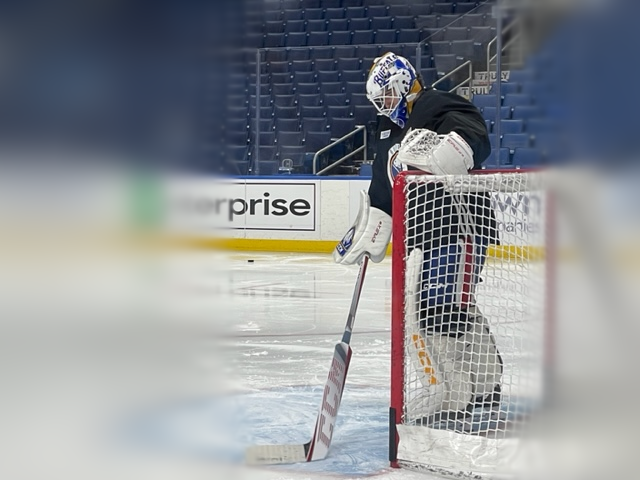
Any player that makes their NHL debut goes through the gauntlet of emotions. Excitement, nervousness, anxiousness…if it makes you feel like jumping out of your skin, that’s what it’s like. It’s a brain going at light speed trying to sort through everything that’s to come.
Goalies are a different kind of hockey player though. They’re famous (maybe infamous?) for their quirks and superstitions and just kind of being out there. And really, to want to get in front of pucks blasted at 100 miles an hour you have to be wired differently.
When it comes to Devon Levi, he’s a goalie but he’s a classic bright-eyed, excited 21-year-old whose professional hockey world is about to open up wide. He’s thoughtful, he’s humble yet confident, and he cannot wait to play against the New York Rangers on Friday night in Buffalo.
“I’ve been dreaming of this moment my whole life, so for it to finally be here, it’s a big deal,” Levi said Thursday. “I’m really excited.”
Think of how cool it is to say you’re fulfilling a dream. Also think of what it’s like to have your stomach feeling like it’s doing cartwheels in a cement truck. Spinning, spinning ever onward until you almost puke.
Levi is a cool customer talking about this and part of the reason for that is because he has a pregame routine and a way to meditate on what’s to come and the studying he’s done to prepare for the Rangers. Going from college to the NHL has its challenges and adjustments, but preparation does not.
“Nothing’s changed, just moving up levels. It’s still the game of hockey,” Levi said. “I still know what I have to do to be successful, so it’s just sticking to my bread and butter, to my base, and just performing it like I always do.”
Hearing him speak about that and going back and re-reading it as well, it’s fascinating that the ultimate takeaway from such a momentous occasion, one for Levi that also includes the weight of a fan base beyond hopeful he’s the next in a line of great Sabres goaltenders, is that it’s just another game. Maybe that’s why he’s now a professional hockey player and the rest of us are watching and talking about it.
Surely it can’t be like that for other goalies. An NHL debut is a big freakin’ deal after all. The gamut of feelings has to be run before hitting the ice, right? Levi’s zen-like approach to everything has to be particular. There’s no way it was like this for other goalies when they made their NHL debut, right?
The content below was originally paywalled.
“For me it was mostly just kind of sticking to what works,” Ukko-Pekka Luukkonen said. “For me the best thing has been just to treat it as like a normal day. Of course, it’s exciting and you want to enjoy it, but when you have played yourself to be in the position to get the NHL debut, you know you have done something right and something has been working for years so why change it?”
Luukkonen made his NHL debut in late April of 2021 against the Boston Bruins. That was during the Covid-shortened 56-game season and it got him a win in his first game. He made 36 saves in a 6-4 win, one in which Sam Reinhart had a hat trick and the Sabres chased Tuukka Rask from the game after he gave up four goals. Jaroslav Halák took over and wound up giving up the game-winning goal and took the loss. Halák will start for the Rangers against Buffalo on Friday against Levi for his debut. Some would say time is a flat circle even though that came just two years ago.
Hockey players are creatures of habit and routine. It’s all part of the process of preparation and each player does something different but the endgame is the same. To be in the best mindset and physically prepared for a physically and mentally demanding event on the ice. In Luukkonen’s case he made three different North American debuts in the span of roughly 18 months while navigating the pandemic. That made his situation uniquely particular on top of each level of pro hockey having its own different challenges.
“It was a great learning experience, and growing up, you realize that getting ready for your NHL starts, and especially the first NHL start, I didn’t feel like it was the hardest thing to do ever,” Luukkonen said. “I think, let’s say we play we play in Rapid City on Tuesday, nothing, nothing, nothing wrong with that, but I felt like that was way harder to get your mindset ready and focus on that game.”
For Eric Comrie, his NHL debut came suddenly late in the season in 2017 with the Winnipeg Jets and it was part of a more regular process, at least as far as how it can be for goalies. He played in the Western Hockey League with Tri-City for junior hockey and went to the AHL after that. Like Levi, he was 21 years old when he got the call.
“I played against Grand Rapids the day before my first NHL start, or two days before, had a really good game against Grand Rapids, and the team pretty much said, ‘We’re going to reward you for having really good game in American League and we’re going to give you a call-up,’” Comrie said. “And I got called up and, I mean, I was nervous, excited, but for myself, we just treat like any other day.”
Comrie made 35 saves and got a 5-4 win against the Columbus Blue Jackets. Jacob Trouba had two goals, Bryan Little had four points and Mathieu Perreault had three for the Jets. In the big picture for all of us, it was like any other game. It was a late-season game that probably didn’t get a whole lot of attention. While the game means something to Comrie now, in the moment and in a day of preparation, all that excitement and the big personal moment part of it seemingly takes a backseat.
But that kind of focused approach is very common and sticking to what you know is what helps allow a first NHL game to be no different than one at other levels. That’s part of the best advice Comrie got when it came time to suit up for the Jets that first time in 2017.
“You play so many games, just treat it like any other game was the big thing,” Comrie said. “I didn’t try and treat it any different than any other game I ever played, and that was the biggest thing. It doesn’t matter if it’s an American League game, NHL game, Western League game, for myself, it’s all just the same thing. Just go out there and do my thing and doing what I can control with my process.”
It’s not a surprise that Luukkonen was coached up in a similar fashion.
“Goalie coaches helped me and teammates and all that, but it was more just kind of knowing what works for me and sticking to that and to not think about it too much,” Luukkonen said. “In the end it’s the same game of ice hockey and just a better and bigger level. That’s kind of how I attack the day.”
The other part of cracking the NHL and playing that first game in goal is the adjustment, not with the equipment or the travel, but with how good everyone in the NHL is. This is where the paths Comrie and Luukkonen took to get there differ from Levi.
Luukkonen and Comrie got to warm up for the NHL in professional hockey at lower levels with the ECHL and AHL. Levi is going from the NCAA to the NHL. That change of pace is an eye-opener.
“The jump from the American League to the NHL wasn’t huge, the jump from junior to the AHL was a big jump. That was a bigger jump than AHL to NHL,” Comrie said.
Comrie was 18 years old when he went from juniors to the AHL while Luukkonen was 20. That increase in talent is exponential. When forwards and defensemen have to adjust to the size and speed of opponents at higher levels it means making decisions faster and knowing how much more physical the game is there. The view from the crease for such a graduation is like going from playing on rookie mode in a video game to legendary and the size and speed create their own problems.
“You stopped playing against 16-year-olds and start playing against 29-year-olds, 30-year-olds, it’s a little different,” Comrie said. “When you play against 16-year-olds, they put a lot of shots in your chest and they aren’t coming very hard, it’s a lot easier. When you go against 30-year-olds, 29-year-olds, they can pick their corners. They know how to play they’re bigger, stronger men.”
Levi is coming from a level that has a mixed bag of ages and experience. College players range anywhere from 18 to 24 years old. It’s a wide range that very well could help him settle in faster than not. But there’s only one way to find out and that begins on Friday night, a night apparently just like any other.