

The core of the team is set for nearly the next decade, how they surround them becomes the key to the Sabres future of success.
To get ready for the upcoming Buffalo Sabres season, I’ll be previewing most of those involved in the eventual successes and failures by going through the alphabet using a different word each time – a revolutionary theme if there ever was one.
Enjoy, and if you’re not a subscriber, sign up today to read everything in full.
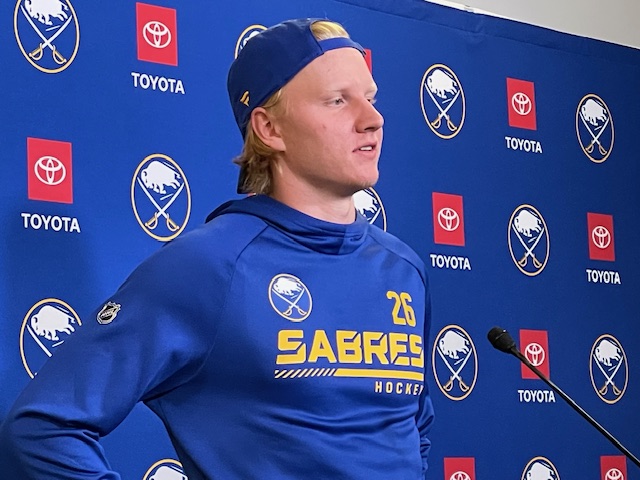
When Rasmus Dahlin signed his eight-year, $88 million extension on Monday, it was the least surprising development. Similarly, Owen Power’s seven-year, $58.45 million extension signed on Wednesday night was also expected business, albeit more of a mystery as to whether or not he’d sign a long-term deal or a bridge contract.
But when it comes to the blueprint of how the current iteration of the Buffalo Sabres was constructed, these two contracts were the final cornerstones that needed to be set in place. General manager Kevyn Adams got long-term deals done with Mattias Samuelsson, Tage Thompson, and Dylan Cozens completed last year, and now with Dahlin and Power locked in place for the foreseeable future, the Sabres core is fully established.
The core was never in doubt, the plan has been clear from the beginning. These are the players they’ve identified as the ones that will lead the Sabres back to the postseason and attempt to bring the franchise their first Stanley Cup someday.
“You can be patient, but you also have to be persistent,” Sabres coach Don Granato said Monday. “And Kevyn, I think has been very persistent in the type of people we want here. There’s lots of talented hockey players around the world but we want to get the right people and Kevyn and the entire staff, they’re very persistent. Although we’ve been patient, you’ve got to be persistent, and we have. I think this is one, to have this player, Rasmus, clearly state, ‘I want to be here long term,’ I mean, the market’s the market. He’s in the market so you can do that anywhere, but he says, I want to be right here. That’s pretty nice.”
Dahlin, Power, Thompson, Cozens, Samuelsson… those were the easy calls to make. Now the hard part to come is figuring out who best to surround them with to become one of the NHL’s elite teams. They may already have a few candidates on hand already.
The content below was originally paywalled.
The importance of a building team to identify who makes up their core to build around doesn’t need to be overstated. We’ve seen how teams like Chicago, Pittsburgh, Tampa Bay, and Colorado have done that in recent years and if you want to go back further, Detroit, New Jersey, and the OG Colorado Avalanche did that 20-plus years ago. Teams draft or acquire great players and make sure they don’t go anywhere for a long time. It’s roster management set on easy mode.
As seemingly simple as it seems to set up the core, we’re all aware that’s not all it takes. We don’t have to look too far back in Sabres history to know that having a few very good players isn’t close to enough to vault a team into the postseason. We don’t need to go back and relive the past with the errors of their ways—those days are gone, and the bad men aren’t coming back—but one look at the other players on the current Sabres roster can illuminate the different approach they’re using this time around.
Whether it was through trades, the draft, waivers, or free agency, the roster is solid and the depth beyond the current group that is in Rochester shows the path that lay ahead at more than a few positions. But this isn’t a moment to snipe and nitpick about players they’ve traded to build this group. Most of those players have gone on to have wild success elsewhere and good for them for landing in situations that led them down that path.
But with Alex Tuch, they have a more veteran player who’s been there before in Vegas. Casey Mittelstadt has been through the mire of sorting through the bad times and grew to become a vital player last season. That kind of story is hard to ignore and it serves as an example to even younger players that it’s not always going to be easy. And now with Peyton Krebs, JJ Peterka, Jack Quinn, and Zach Benson they have their second wave of youth to drive the team. Matt Savoie will be part of that in the near future whether it’s this season (sooner or later on) or next year. With Isak Rosén, Jiri Kulich, and Ryan Johnson in Rochester they’ll be asked to contribute when injuries arise this year and to potentially (likely?) be major factors next season.
This is why building out the pipeline and continuing to keep it stocked is vital. Keeping picks and making picks to draft the guys that could one day be the next key components is good. Being able to part with guys later on should a trade materialize to solidify their chances to make or go deep into the postseason becomes a viable option as well. It’s always nice to want to organically build a team, but sometimes a GM has to make the hard decision.
Those days will come at some point and that too is OK. It’s not like it felt great to trade Jack Eichel or Sam Reinhart after all, but it was a vital means to an end to build this team. But now that the blue line is set for a long time with Samuelsson, Dahlin, and Power, the future is now for Buffalo.
“I got on our guys really hard with about 20 or so games left last year, and I said, ‘Young is getting old,’” Granato said on Thursday. “Meaning I’m sick of hearing we are young and whatnot… We put a real premium on developing, immersing, and experiences to grow faster. So, I do feel like even though we are young, we’ve gained a lot of experience that we now need to know we are executing on gaining that experience. And that’s how I feel. I mentioned that we have that ability to bring a young player in like Benson because he is surrounded by more experience than our younger guys were a year ago. I think we’re in a better position to handle a younger guy now than we were a season ago when we had three younger guys, Power, Peterka and Quinn. We are better suited now with only one entry-level guy at this point.”