

In order for young players to become better fit to handle professional hockey, they’ve got to get stronger. Best friends Jiri Kulich and Isak Rosén have done just that.
To get ready for the upcoming Buffalo Sabres season, I’ll be previewing most of those involved in the eventual successes and failures by going through the alphabet using a different word each time – a revolutionary theme if there ever was one.
Enjoy, and if you’re not a subscriber, sign up today to read everything in full.
Brawn
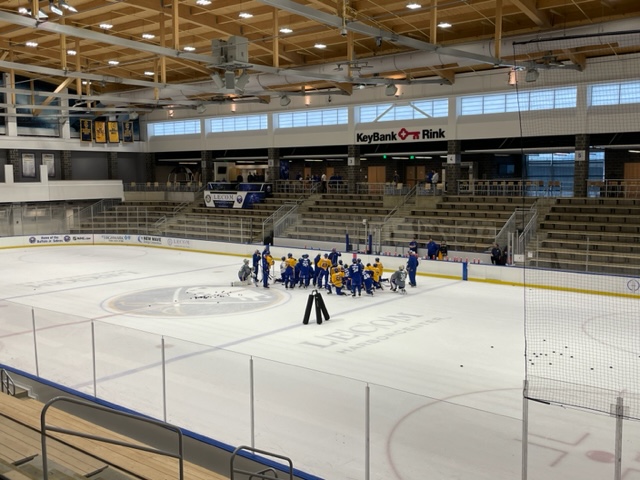
The lure of making it to and staying in the NHL drives every player to do what they have to in order to accomplish that goal. For younger players, there’s a learning period that’s accompanied by adjustments and growth and either players make it to the NHL and blossom from there or they spend days/weeks/months/years to reach that apex…or they don’t.
Looking back at last year’s Rochester Americans team that had all kinds of young high-end talent on the roster and the impact those players had, namely forwards Isak Rosén and Jiri Kulich, and what that year in the world’s second-highest professional hockey league meant for them as they head into training camp this year, perhaps the biggest thing was how much they needed to grow physically to better adjust.
With an entire season of games in the AHL followed by a deep playoff run that ended with a tough series loss to the eventual Calder Cup champion Hershey Bears, the education put forth from that experience let those players know exactly what they would need to become more impactful moving ahead: Strength.
Although their offseason was abbreviated because of the playoff run, Rosén and Kulich arrived in Buffalo for the Prospects Challenge bigger, more knowledgeable, and ready to shake things up when Buffalo Sabres training camp begins September 20. Kulich, in particular, looks stronger and built even more like a professional.
“As strong as he was for an 18-year-old last year, he looks outstanding,” Americans coach Seth Appert said this week. “Physically looks like he had a very explosive summer. So, good for him for not being overconfident about his year he had and putting in a lot of work. It’s very evident.”
The content below was originally paywalled.
Kulich and Rosén, despite being from different backgrounds (Czech and Swedish) bonded immediately a year ago during prospects camp in Buffalo and that friendship grew stronger throughout the year in Rochester. They push each other on the ice and bust each other’s chops off the ice in the way young guys do all the time.
On the ice, it means helping each other score goals and create opportunities, like the power play goal Rosén set up for Kulich late in their 6-3 win over Montréal. Although they’re competitive by nature, that competition doesn’t quite extend to how their offseason workouts and bulk-up went.
Kulich said he added 16 pounds in the offseason, a truly staggering amount. Last season he played at 170 pounds, but he is indeed 186 this year. Rosén said he put on about 10 pounds of muscle, although he’s listed at 173 pounds in camp he was down for 168 last season. Regardless of what he’s written down for, he plays much stronger than whatever the three-digit number declares.
“I think it’s going to help me to be a little bit heavier now,” Rosén said. “But also, I can control it, so I don’t lose my speed and stuff like that. So last year I couldn’t just bulk up. I didn’t have like the time to add maybe 10 pounds more muscle like I do now.”
It seems odd to want hockey players to be heavier given that the game is about speed and strength, but with younger players who are still in the process of getting older and naturally growing and gaining strength, weight is a big deal when competing against the best in the world. Think of the size of players like Alex Ovechkin and Victor Hedman, forwards and defensemen alike, they’re big, strong players that wear out opponents with their talent and size. Then think of the struggle it can be to add weight and strength for some players (Tage Thompson for instance) and what it means to do it the right way, the sustainable way.
Getting this part of development is an understated necessity for any organization. Adding weight can be easy when it’s done wrong and strength and conditioning is something the Sabres are trying to get right immediately for their up-and-coming players.
“The five forwards that were rookies with us (last year), four being teenagers – number one, they all put on lean muscle mass in-season last year,” Appert said. “That was a goal of ours going into the season, was we were going to lift those guys – those five – so much in-season that we were going to put lean muscle on them during the season. Nick Craven’s a phenomenal strength coach. He did a great job and they put great work in, so that was one. That set them up for a better summer because they weren’t losing 10 pounds in-season, right? But you can see just with the eye test how much work those guys did. They look outstanding. They put strength on, they put the lower-body and the core.
“As a coach as long as I’ve done it, you get the eye test and more often than not you can tell the guys that put the work in, and those five in particular all look excellent and look like they’ve had very productive summers, which is impressive because they didn’t get home until the second week in June, so their summer was shortened. But those kids, they look like they had really good summers.”
For the guys like Rosén, Kulich, and Kisakov who spent all last year in Rochester, the need to get stronger was evident right away. For Savoie playing junior hockey in the WHL against peers with similar builds in the same place in life, it may not have been as striking a need. When he was inserted into the Americans lineup in the AHL playoffs against Hershey, however, it was a wake-up call.
“Obviously, they had a really big D-corps,” Savoie said. “They like to get their checks in whenever they could. So not being able to kind of skate away from guys like you are in junior is definitely a bit of an adjustment I was able to work on this summer.”
Adjusting to that change in size (as well as speed and space and timing) is a learn-on-the-job moment every player has in their career. Savoie got a big dose of all of it in the Calder Cup playoffs, but the size adjustment is one where a fully healthy offseason goes a long way. Savoie’s shoulder injury last summer kept him from getting the ideal offseason and stresses the importance of good strength training for players when they’re younger.
For players like Savoie, there’s also the balance between good strength training and maintaining speed as well. Getting stronger means more weight but smart weight gaining through strength training makes it all part of a vital cycle of health and fitness within sports. After Savoie’s two goals and overall lights-out performance Friday night in the Prospects Challenge, the early returns show how important it is to get that time and use it well.
The overall results in the first game against the Canadiens showed a lot for such a small sample in a game against other prospects. But that they got goals from Kulich, Rosén, and two from Savoie illustrated that these guys came into camp ready to show what they’ve done in the summer and that they’re ready to start making a case for the big club next week.