


The Sabres avoided arbitration and re-signed their defenseman to a two-year, $12.5 million deal and made things a little more confusing for the time being.
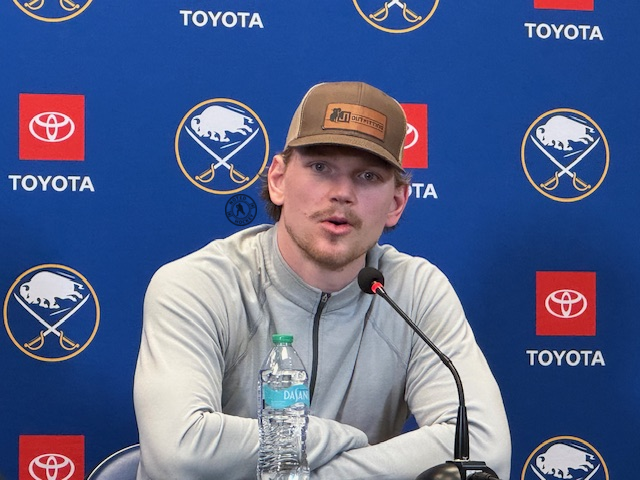
While we waited for what seemed like an inevitable trade, the Buffalo Sabres and RFA defenseman Bo Byram avoided arbitration and agreed to a two-year, $12.5 million deal that comes with a $6.25 million cap hit.
Since the start of the offseason, the feeling was that Byram was a bit of a luxury player on a team that needed help in other areas, thus making him someone to be traded to acquire said pieces. That feeling grew stronger when Buffalo traded J-J Peterka to Utah for Michael Kesselring and Josh Doan and when the NHL Draft rolled around, waiting for the shoe to drop on a Byram trade was something everyone was doing.
After all, it made sense to trade Byram for a forward to help replace the production lost by moving out Peterka. On paper, it was a logical move to make, and the anticipation level of this particular move was quite high.
Instead of a trade, we’re at another pause moment seemingly waiting for a different payoff. If you knew nothing of the situation and viewed Byram’s contract in the moment, you’d call it a solid “prove it” deal with the big exception being that when the contract ends, he can sign anywhere he wants to as an unrestricted free agent.
It’s fascinating. It’s odd. It still feels like there’s something more to come. Even stranger still, it’s what this does to the Sabres depth chart if you view this as a moment of closure on the situation.
Let’s digest this.
The content below was originally paywalled.
We’re going to kick off this breakdown by starting with the blue line depth chart before we dig into the financial breakdown.
With Byram re-signed and understanding that a guy making more than $6 million per year is not going to be playing on the third pairing, that means we’re putting Byram with either Rasmus Dahlin or Owen Power and given how things worked last season, we’re siding with Dahlin. Byram’s best moments came with Dahlin and by playing on a pair with Dahlin it also hid his weaknesses best. That benefits everyone.
The concerns with Byram are interesting. He’s highly skilled with the puck, he has a very good shot, he plays physically despite not being overly big in size, and when he’s at his best and playing with confidence he’s a blast to watch.
Nearly 50 percent of his ice time at 5-on-5 last season came paired with Dahlin (626:24 with, 705:27 without) and Byram’s numbers with and without Dahlin are stark.
Shot Attempts For percentage: 54.07 with Dahlin, 44.99 without
Dahlin’s SATF% without Byram: 56.41
Goals For percentage: 70 with Dahlin, 48.15 without
Dahlin’s GF% without Byram: 50
Expected Goals For percentage: 54.48 with Dahlin, 41.92 without
Dahlin’s xGF% without Byram: 54.99
This isn’t a grand unearthing of state secrets by sharing these numbers, but if you watched the Sabres enough last season and wondered why Byram looked a little different when he was paired with Owen Power (301:58), Connor Clifton (242:52), Jacob Bryson (115:19) or Henri Jokiharju (102:30) there are a few reasons, but most of all he looked worse off because he wasn’t with Dahlin.
Dahlin’s that damn good and anyone paired with him is better off for it. That’s why if Byram is truly here to start the year, he’s the guy that likely starts on a pair with Dahlin. Those numbers are so different and although a full training camp and preseason schedule should give them time to try out any kinds of combinations they want to, you also don’t just pay Byram $6.5 million per season to patrol on the third pairing either.
If you still feel like Byram’s stay in Buffalo won’t be for long, you’re not alone. The Sabres’ need for a sure-thing top six forward to replace J-J Peterka’s offense is still there and Byram is still the guy that sticks out the most as a player who could be traded to land one.
That said, if Byram stays with Dahlin and that pairing resumes putting up strong numbers and Michael Kesselring is the guy that gets Owen Power settled down and Conor Timmins remains as solid as ever as a third pair defenseman then maybe you don’t mess with what works and stick with it. But like the questions with the offense, the answers on defense contain a lot of “ifs” for them to work.
That’s not comforting.
As for those pairs…. Here they are and this accounts for all defensemen signed to NHL contracts. Some pairs aren’t/won’t be pairs and are just listed as such for depth purposes:
(handedness is by side unless otherwise noted in parentheses)
Bo Byram — Rasmus Dahlin (L)
Owen Power — Michael Kesselring
Mattias Samuelsson — Conor Timmins (unsigned RFA headed to arbitration)
Zac Jones — Jacob Bryson (L)
Ryan Johnson — Zach Metsa
Jack Rathbone — Mason Geertsen (L)
Nikita Novikov — Vsevolod Komarov
Isaac Belliveau (L) — Radim Mrtka (WHL – Seattle)
The defensive depth here is actually pretty good and the conventional thought that you can never have enough defensemen is wise. We’ve seen what’s happened to the Sabres in the past when the depth was lacking and when it got thin, it did so quickly and when defense gets thin, it’s beyond noticeable.
You’d have to imagine the Sabres will carry eight defensemen again unless something goofy (read: bad) happens. A three-goalie system is something everyone hates, and Ruff didn’t care to have two extra forwards given the lack of options it meant he’d have on defense otherwise. For those reasons, that’s why Bryson and Jones are part of the NHL roster here.
Obviously, there are guys in Rochester who are there on AHL contracts who will slot in the Rochester group as coach Mike Leone sees fit, namely Peter Tischke and Noah Laaouan. They likely won’t figure into the regular Americans lineup, but if they’re in ECHL Jacksonville they’ll be part of the depth for Rochester if needed. Both Tischke and Laaouan were good organizational soldiers in that regard last season.
Mrtka, who just signed his entry-level deal on July 15, should be headed back to Seattle in the WHL this fall after getting some play during the Prospects Challenge (Sept. 11-15 in Buffalo) and possibly during the preseason. That’s the only reason he’s slotted as low as he is. He’s not a pro player until he is, officially.
One guy who’s a wild card is Geertsen. He is a Tough Guy in capital letters for a reason. He’s going to be physical and he’s going to fight guys, whether it’s in Rochester or Buffalo. He played for Lindy Ruff in New Jersey and was the official/unofficial message-sender there. Do not be surprised if he spends time with the Sabres this season. Geertsen also played up on the wing when he was in New Jersey and, again, if he plays that kind of role in Buffalo at some point, it’ll be a deeply tiring talking point split along traditional lines of belief.
For what it’s worth, Geertsen hasn’t settled on fighting the little guys during his NHL time. If anything, he’s made it a point to be noticed by those connected to the Sabres for years:
We respect guys who fight around here, especially if they’re willing to tangle with the likes of Kassian and Zdeno freakin’ Chara. You had to have a screw loose to want to tangle with Chara because there was no one scarier than him when he was pissed and eager to fight. Given how Geertsen took to the role playing for Ruff, there’s no doubt Ruff had some insight into that addition. As for the role he’ll have in Buffalo and/or Rochester, Adams was clear about it at the start of July.
“I just think that it’s a unique skill set, and he brings it and he’s proven it,” Adams said. “Lindy coached him in New Jersey so that’s helpful as well, just to know the type of guy you’re getting to the organization. But he and I had a good chat yesterday, and he’ll be ready to go.”
Those reasons alone aren’t quite enough to have Geertsen unseat Jones or Bryson for a spot on the NHL roster, but if there are any recreations of what went down this season with Tage Thompson or Rasmus Dahlin getting messed with or hit late without an answer… it’s a short drive to get to the NHL from Rochester.
There are some guys to be proud of and to keep an eye on if things get really sideways with injuries, of course. Metsa’s game has gotten progressively better since he was done at Quinnipiac and signed with Rochester a couple years ago. Now that he’s on an NHL contract, there’s a real chance we see him play at some point in Buffalo. The compacted schedule thanks to it being an Olympic year means any injuries become a big deal.
Ryan Johnson’s long-term commitment (three years, $2.33 million; $775,000 AAV) comes with a two-way contract in the first year. In case your brain is still poisoned by how EA Sports’ NHL games got the two-way contract concept wrong for so long, it just means he’s paid less if he’s in the AHL than the NHL when on a two-way deal. That makes it less expensive to send him down to Rochester this year and that should mean that’s where he’s ticketed to be again anyway.
Johnson can force the issue in camp and throughout the season, of course, and while he’s improved the past year, there are still some things here and there you’d like to see worked out for him to be a steady NHL presence. You’d like to see him be more helpful defensively, even though his defensive awareness is good. Then again, if he can just be a really strong two-way defenseman who can be good with the puck and strong enough against it in his own end, that’s perfect.