

Buffalo appears set to run it back with the same trio they ended last season with and that’s curious, isn’t it?

In the past few days/weeks, I’ve done a few radio interviews and may have even mentioned in the most recent episode of Maintenance Day, but I have a working theory about why the Buffalo Sabres’ only moves regarding goaltending pertain to the Rochester Americans and not necessarily at the NHL level.
Goaltending was a major issue last season as a lack of consistency plagued the team all season long. Attribute that to injuries skewing starts and the rotation or to Craig Anderson’s limited availability due to being 41 or how the team played in front of them. They’re all part of the problem but no one of them is the sole issue and it’s led to virtually everyone to conclude they’re going to address the position during the offseason.
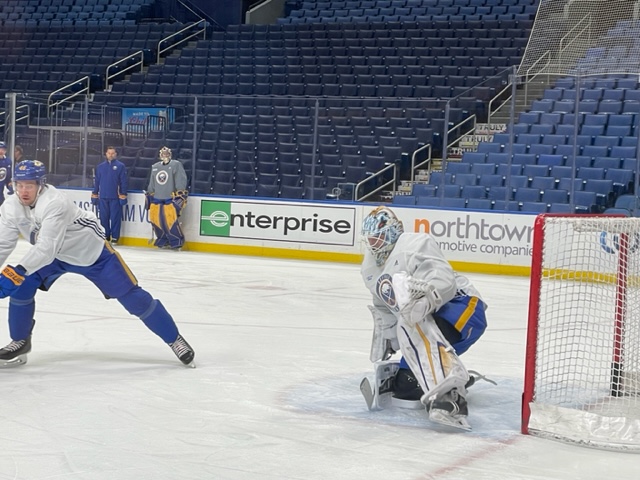
Kevyn Adams has addressed it a couple times saying he believes he has three NHL goaltenders in Eric Comrie, Devon Levi, and Ukko-Pekka Luukkonen. And yes, they are all NHL goaltenders, those facts are undeniable. They’ve made it to the NHL and are capable of shutting down opponents.
Levi is clearly the one they’re hoping takes the No. 1 spot and runs with it for years to come. He was the goalie of choice to try and rally them into the playoffs last season despite having just left Northeastern.
Adams spoke about how he had Luukkonen over to his house for dinner and to watch some of the playoffs before he headed home to Finland for the summer. Adams says he believes in him, and he’s said it a few times now.
Comrie dealt with injuries and inconsistent play but played well late in the season.
Still, the trio offers far more questions than answers and my thought as to why they’re sticking with who they know is because those three know best as to what they’re dealing with in front of them.
Let’s kick this around a little bit.
The content below was originally paywalled.
Sticking by three goalies who rode the roller coaster when it comes to their play or are totally brand new to the league is a huge risk for a team that’s essentially in the mode to make the playoffs…or else.
But there’s something about acquiring a goalie from the outside that has just as much risk as running it back. Adding a higher-end veteran to mind the net looks great on paper and even better in video games, but there’s a learning curve behind new players and systems and sometimes that’s something that can’t be figured out by watching a lot of videos. Even breaking down the numbers only produces a fraction of a part of a picture.
I’ll call back to a tweet from Sportsnet 650’s Gregory Balloch referring to Winnipeg Jets goalie Connor Hellebuyck. He showed a clip of how Hellebuyck’s foot speed following a pass in a game against Anaheim led to a goal because he couldn’t stay on his feet, something that happens with regularity.
For a lot of teams, particularly those who play more defensive hockey, those kinds of plays are fewer and further between. Thinking of how the Sabres play in the defensive zone, however, gives such concerns about Hellebuyck credence.
Buffalo’s in-zone and transition defense can sometimes get a bit…loose. A more wide-open kind of game could lead to problems for every goalie, but if those plays are a bit more common, the rise of incidences where a goalie is smashing their stick on the goal aren’t coincidental. The same can be said of turnovers within the zone which past Sabres teams were very guilty of doing, a bit less so with the current iteration.
But I had to look at some deeper statistics to see if my theory holds any truth, even a smidge. Tracking rush statistics is hard as hell to do and Corey Sznajder is one of the best to do it. His tracking work at All Three Zones is outstanding and doing it as a one-man gang is beyond impressive.
Warning: advanced statistics ahead—proceed with caution
Examining what he compiled from this past season regarding what they get versus what they give up on the rush shows the Sabres are, in his delightful wording, the one of the most unhinged teams in the NHL.
His analysis shows the Sabres generate the most entries that lead to chances per 60 at 5-on-5 in the league (12.6) just ahead of the Devils (12.5). However, they allow 12.1 chances per 60 which is sixth most trailing Arizona, Chicago, Anaheim, Montréal, and St. Louis. Sabres games are a lot of fun to watch because the pace is played off the charts and the chance trading that goes on makes it so.
Comparing the Sabres stats to Winnipeg’s, the Jets allow 11.3 chances per 60, just slightly below average. By no means did Hellebuyck have it easy in Winnipeg, but Rick Bowness’s system also makes the non-rush action to be more basic and straight up. Hellebuyck’s high danger shots faced per 60 was 8.2 at 5-on-5 (via NaturalStatTrick) compared to Levi (11.6 – third most among goalies with 350 or more minutes), Comrie (9.8 – 13th), Anderson and Luukkonen (9.4 – 19 and 20).
Shots lead to goals against and using the above numbers, the goals are unflattering. Comrie allowed 1.84 high danger goals against per 60 at 5-on-5 (t-10th most) while Luukkonen allowed 1.81 (13th most). Levi was at 1.51 (33rd) and Anderson 1.45 (t-38th).
A total of 80 goalies had 350 or more minutes at 5-on-5 and Levi and Anderson were the best but still just about average-to-below-average compared to the rest of the league. Hellebuyck had 1.37 which placed him 45th, firmly in the median. Keep in mind also that Levi has the fewest minutes played of all qualifying goalies with 358 minutes. It’s a small sample size but that was always going to be the case.
Those are starkly vast differences and a major reason to consider why making a big splash addition like that could backfire. Of course, it’s numbers like these that led to the Sabres signing Erik Johnson and Connor Clifton to strengthen the defense. Both players, via Sznajder’s numbers, are what he rates as conservative defenders, meaning they’re not denying a large percentage of entries despite seeing an above average number of opponents carrying in against them (read: not getting stuffed at the blue line). By that measure, they’re very similar to most of the defensemen on the roster already.
However.
How those entries compare to chances allowed is the big difference. Sabres defensemen last season struggled to limit chances against on entries. In Clifton’s case, teams avoided entering the zone against him as he faced fewer than average entries against and was excellent at limiting scoring chances against when players got around him. In that same measurement, Johnson compared similarly to Henri Jokiharju, although Jokiharju was targeted fewer times on entries.
This is the roundabout way of saying the Sabres have acknowledged the issue and did their best to address it with their signings. If I’m one of the three goalies in the fold right now I’m relieved and excited to see it and can’t wait to see it in action. If I’m a goalie outside of the organization that’s been rumored to Buffalo, I’m wondering if that’s enough to make things less hectic enough to not (potentially) damage what to ask for in a new contract.
It’s not so much the Sabres are running with the mantra of “go with the one that brought you” so much as it is about sticking with those who know what they’re dealing with in the first place.
Again, this is just a theory I’ve kicked around and I’m willing to accept any criticism of it. But I’m also from the school of using the scientific method to work through it. Watching the game certainly shows us easily that the Sabres played firewagon hockey last year and the goalies had their hands full because of that.
Goaltending can be so volatile year after year and introducing someone new into the equation who may not be ready for that heat could mean the adjustment time in actual games makes things a bit more painful, if they can adapt well at all or their natural play style hinders them.
If that’s why Adams and company are holding fast to the guys they have, then I can understand. A trade for someone with a bigger reputation means giving up a boatload of futures and doing that for a player who may not perform up to expectations that’s in a free agent year (Hellebuyck) or has a lot of contract left (Gibson) computes. Weighing calculated risks against gut instinct and what your eyes tell you works well in the ether, but for a team executive that’s a move you cannot be wrong about.
Adams hasn’t shown any signs of having a paralysis of decision making and that’s what makes me hold firm with my idea. That or he’s gotten much better with his poker face and selling us on what he’s saying. Because if he’s been scrambling to land a goalie and he’s been frustrated by that, he’s shown none of that.