

The Buffalo Sabres stunning season of success invigorated a fan base and emboldened a talented team to, at long last, believe in themselves. Although the cornerstones for sustained success are in place, the constraints of a cap world and the hockey business is unrelenting, and they’re poised to affect how the Sabres are built going into next season and beyond.
Alex Tuch’s impending unrestricted free agency has loomed over the situation for a year and Bo Byram’s similar situation awaits next summer. Zach Benson and Peyton Krebs are restricted free agents now and after Benson’s play in the Stanley Cup Playoffs, what to pay him and how soon to pay him big are up for debate.
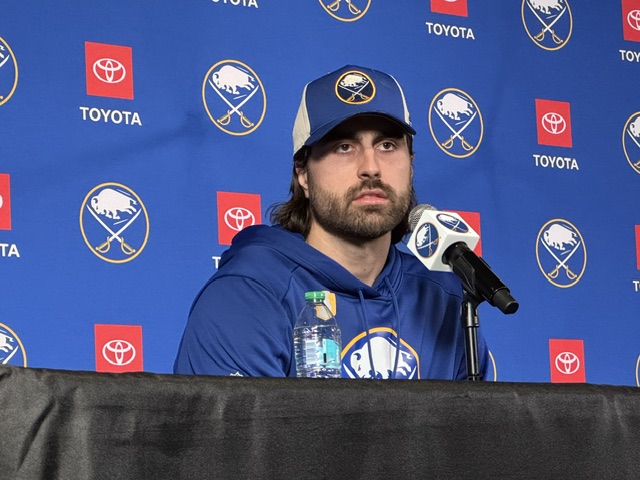
Byram comes to the forefront now after Darren Dreger shared that teams are exploring a trade for the defenseman. After an awkward and difficult summer a year ago as an RFA, Byram wasn’t exactly excited when he was asked about the possibility of signing an extension this July 1 after the playoffs:
“I think there’s a ton of things, first and foremostly being that I don’t want to lose anymore. I want to be on a good team every year, and I want to compete for a Stanley Cup every year. I want to be playing important games every year. And then there’s more personal stuff: where you fit in, what your goal is, whatever. A ton of things that go into it. It’s funny, when I signed my extension last summer, I thought maybe I wouldn’t have to talk about this for a while. I don’t know, just taking things a day at a time, trying to be a good teammate, work on my game, improve and put myself in the best position possible. I’ll continue to try to do that over the summer.”
When it comes to the business side of hockey, Byram isn’t excited to talk about that with us and after all the talk a year ago, having this hanging over him all year can’t really make him smile. Then again, his agent is Darren Ferris and, traditionally, he likes to take guys right to free agency to cash in. After sorting through Tuch’s situation this year, doing it again next season with Byram can’t have the Sabres excited either, especially because Byram will be able to command big, big money as a high-end defenseman.
What happened with Tuch’s negotiations last July 1 doesn’t fall on Jarmo Kekäläinen’s head, but what happens with Byram come this July 1 will. Unfortunately, these two may be intertwined in fates.
If Tuch moves on elsewhere, that leaves a big hole on the wing and for as much talent as the Sabres have up front, replacing what Tuch does so well would be incredibly difficult. He’s a great two-way player and a weapon at 5-on-5 and on the penalty kill. Guys like Benson or Konsta Helenius could be like that as well, but they’re also very young. Tuch’s career experience gives him an advantage there. Players like Tuch that aren’t Tuch aren’t generally available as free agents, which means finding a player like him has to happen via trade. If Byram is set to go right to next July 1 and become one of the big-ticket free agents and choose his destination (if it’s not Buffalo, that is), then moving him to acquire a Tuch-like forward makes sense.
Of course, players like Byram are also not easy to find and as the Sabres demonstrated throughout last season and postseason, their top four with Dahlin, Power, Byram and Mattias Samuelsson is among the best defense corps in the league. We saw the highs and lows of what Byram can do in the playoffs.
Against Boston, his speed and play with the puck were deciding factors in that series and his ability to score goals shined. He was arguably their best player in the series and helped finish the Bruins off in six games because of his play. Against the Canadiens, however, Byram struggled defensively and his puck moving ability and offensive creation was stifled because of how Montréal kept Buffalo on their heels defensively throughout the series. The Bruins and Canadiens’ styles couldn’t be more opposite but, ideally, you want defensemen to be able to adapt fluidly.
The Sabres are a better team with Tuch and Byram, hands down, but with their cap situation this season (roughly $13 million in space), affording Tuch while handling other free agents would be very difficult. Spending the money down the road to keep Byram (he could command $10 million a season) while already paying Dahlin ($11 million per year) and Power ($8.35 million per) big money creates a different kind of financial juggling act. Even though Dahlin sets the bar for Sabres defensemen, there’s no reason why Byram wouldn’t ask for (and get) more than Power based on his offensive output and abilities.
The Sabres have to be focused on long-term gain given they’re very much in a Stanley Cup Contender window now. Sacrificing the short-term would cause things down the road a year or two more painful. Losing Tuch and/or Byram would be painful immediately and obviously dependent on who they acquire to replace them.
If that means making a deal with Toronto for Matthew Knies (rumored), the perils of doing that are obvious. If it’s the Flyers, Blues or anyone else, how does that work out compensation-wise? Buffalo isn’t in a position to take picks and prospects in trades now. Getting NHL players in return in a tried and true Hockey Trade are what will motivate them.
Farewell, Kesselring
The Sabres have already started to address what’s to come by trading Michael Kesselring and the 27th overall pick to San Jose for the 20th overall pick in the NHL Draft. Kesselring wasn’t so much a financial crunch as it was a necessary change of scenery.
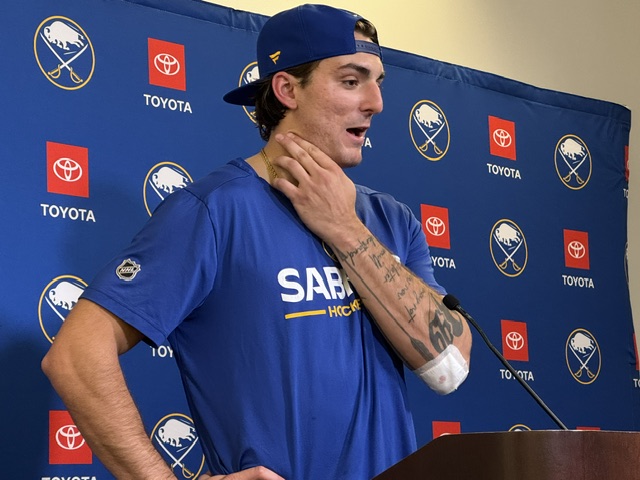
After former GM Kevyn Adams acquired him a year ago from Utah with Josh Doan for J-J Peterka, a combination of injuries and on-ice crimes of passion conspired to keep Kesselring out of the lineup when the season got serious.
Kesselring wanted so badly to make his mark and earn a spot in the Sabres top six on defense with the expectation that he would be a defense partner with Byram, Rasmus Dahlin, or Owen Power. Instead, he dealt with an ankle injury early on that set him back and in his rush to get back did more harm to it. By the time everything was settled for him physically, Zach Metsa’s steady play earned him a steady role, and the acquisition of Logan Stanley and Luke Schenn made the blue line even more crowded.
The semi-open audition of righty defense to see who would play with Stanley on the third pair saw Kesselring out of the mix quickly and his frustration with the situation was obvious. Trying to keep a brave face in that situation is hard, especially when the team is winning and you don’t feel like you’re part of that success. Even more so when it’s a contract year and you can’t better prove yourself.
There’s no doubt Kesselring can be a solid defenseman. His size, mobility and passion for the game are all there and the Sharks are in serious need of blue liners. Nothing is given and everything is earned in the NHL, but if Kesselring can’t crack through and play regular games and minutes in San Jose, something really went sideways.
Of course, Kesselring’s departure and the effect it has on the Sabres is doubly interesting given the new scuttlebutt and reality with Byram along with the potential (likely?) departures of Logan Stanley and Luke Schenn in free agency.