

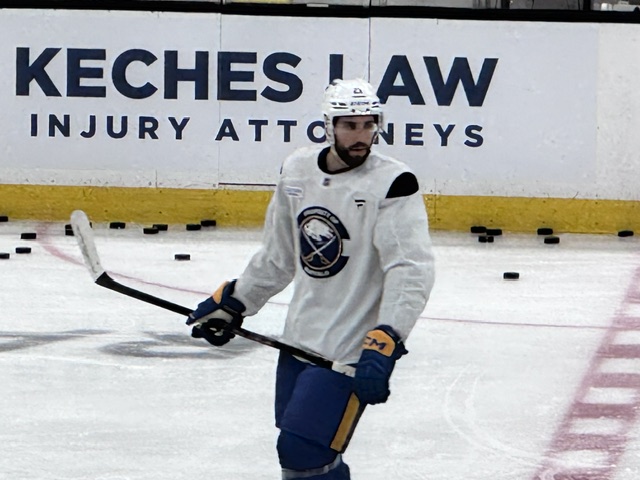
BOSTON – When you’ve got a defense corps like the Buffalo Sabres have that’s built heavily around its top four, figuring out the third pairing would seem to be like no big deal. But if a team is going to go to the playoffs and have designs on winning the Stanley Cup, effective No. 5 and 6 defensemen go a long way.
Throughout the year, guys like Jacob Bryson, Zach Metsa, Michael Kesselring, and Ryan Johnson took turns showing what they could do. When Logan Stanley and Luke Schenn arrived from Winnipeg at the trade deadline in a swap involving Bryson and Isak Rosén, part of that equation was solved with Stanley, but who would play next to him was still up in the air…at least until Conor Timmins returned from a brutal broken leg injury that cost him more than three months of action.
Timmins was part of the mix of defenders aiming to make a claim to the third pairing and for a time he was even on the second pair with Owen Power early in the year. Since returning from a broken leg in late March, he’s earned Lindy Ruff’s trust and has given Stanley a consistent partner. That kind of mix has been necessary for the players themselves and the team all together.
“Really once we got to the last couple games, that left-right combination, the ability to kill penalties (locked them in),” Ruff said. “Timmins had been such a good penalty killer for us until he had got hurt. We felt that five-six had to have a physicality to it, which Stanley had really helped us out, and penalty killing. And the ability that Timmins has got to get up ice, his tight gaps on entries have been good. Really think his first pass coming out of the zone last game was really good.”
While those last couple of games in the regular season weren’t exactly like playing out the string, they locked up the Atlantic Division title in Game 81 in Chicago after all, they provided the opportunity for them to jell better as a pairing. In a way, there was a competition among the right-handed defenders to see who would line up next to Stanley. Timmins was able to find a connection and the pairing stuck. Doing that after such a brutal injury could’ve been difficult, but he was ready to go right away.
“I feel like the first few shifts maybe you kind of get your feet wet and get adjusted to the pace,” Timmins said. “But I felt pretty good about my game from the start (first game back).”
In teaming up with Stanley, there’s a little bit of history. The two competed against each other in junior hockey and Timmins’ Soo Greyhounds team beat Stanley’s Kitchener Rangers team in the 2018 OHL Western Conference Final won by the Greyhounds. Now as teammates and a third pairing that’s finding its groove together, the Sabres just might have something cooking.
“We just both play a simple game,” Timmins said. “Defend hard and, yeah, it’s just been working well so far.”
That’s a solid once-over for how to describe it, but there’s a little more to it than just work hard, play hard.
“I think we understand each other’s games,” Stanley said. “We both like to move pucks and keep the game simple for the most part. That’s easy to read off your partner when he’s kind of in the same wavelength as you. He’s a smart player so I think whenever you put two guys that think the game well together, they usually feed off each other. Obviously, (he’s) a great defender as well. I think just continuing to play together and building a relationship off the ice too is key in what comes on the ice.”
While Timmins has been in the Sabres system all season long, Stanley hasn’t. Coming over in a late-season trade and needing to learn a new system and playing with a host of different partners (Metsa, Kesselring, Timmins, and reuniting with Schenn) made it a challenge for him to find his footing as well.
“It was definitely harder than I thought it was going to be, being traded,” Stanley said. “I’d never been through that before. It was definitely challenging, learning a new system, a whole new group of guys. But I think the biggest thing is how well these guys have been at making feel like a part of the team off the ice and that’s really translated when we go on the ice. It gives me confidence to play my game and be myself out there. I can’t say enough good things about the guys in this room.”
Although fans have been anxious in watching how Stanley and any of his partners have worked out, watching the way they’ve been able to body up at even strength and shut things down while killing penalties has proved to be a good way to keep the more vocal critics quiet. Timmins in particular is a favorite of Ruff’s on the kill and coming up with key blocks late in Game 3 only help endear him to the Buffalo faithful.
“It’s a fun challenge,” Timmins said. “Obviously, there’s some big moments in the game and we have an opportunity to make a huge impact on the game. It’s been a really fun opportunity, and I think as a unit, we’ve been doing a good job of creating pressure and getting in lanes, but I think it’s just a day-to-day thing we’ve got to keep improving.”
It’s a classic hockey trope that guys blocking shots get their teammates fired up, but when you hear the bench banging their sticks on the boards and cheering guys who lay out or find a way to eat a shot, it genuinely does get the rest of the team going. It takes a lot to get in front of a slap shot or any shot and those sacrifices earn respect and highlight how far guys will go to get an edge in the moment.
“One hundred percent (it gives us momentum),” Timmins said. “I think that’s something we’ve been building since the start of the season. Just that culture of our team, you see guys like Mal and Sammy and Kozak diving in front of shots, it makes everyone else want to do it and gives our team a huge boost.”
When you have two guys working together that are wired in similar ways in how they play and think the game, it creates an advantage. It also gives you that kind of pang of wishing they could’ve been playing together longer throughout the year to help late in the season, too, but if Stanley and Timmins can keep up the silent production that comes from shutting down the opposition, it’ll allow the Sabres top four to have peace of mind that they don’t have to do it all to win games.